Basement and garage ceiling insulation cost per m² in Croatia 2026
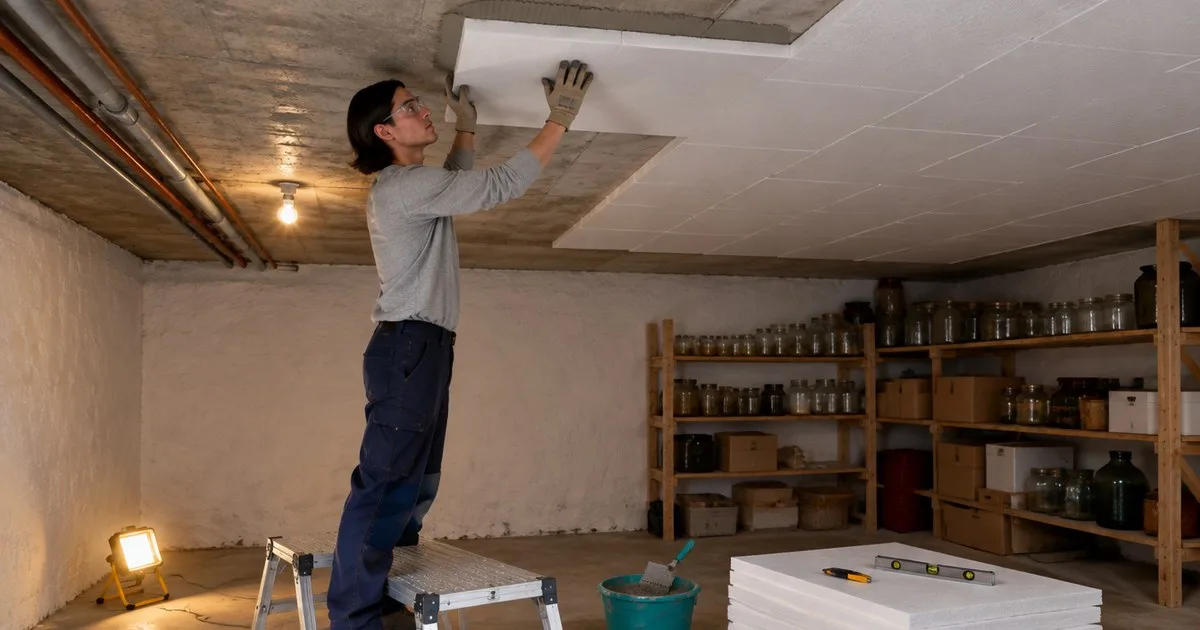
Is the ground floor cold underfoot in winter, even with the heating on? If there is an unheated basement or garage below, heat escapes down through its ceiling. When you search for basement ceiling insulation cost in Croatia, you see figures from about ten to forty euros per m². The gap is large because some prices are labour only, some include materials, and on a small ceiling the price per m² goes up.
This guide gives approximate 2026 prices for insulating a basement or garage ceiling in Croatia: labour, EPS, XPS, stone wool and adhesive. There is also a 60 m² example and a list of questions to ask a tradesperson before you agree on the job.
Basement ceiling insulation cost per m²: approximate ranges
The figures below are approximate ranges from public contractor price lists, tradesperson request portals and shops in Croatia (2025–2026). They are not a Gigron offer or a fixed price. They depend on the city, material, thickness, ceiling height and what the quote includes. Some price lists include VAT and some do not, so always check.
| Item | Approx. (€/m²) |
|---|---|
| Basement thermal insulation with moisture-resistant boards, labour + materials | ~18–25 |
| Small basement ceiling (about 33 m², 8 cm EPS), estimate for the whole job | ~27–45 |
| Labour only: ceiling thermal insulation (excl. VAT) | ~10 |
| EPS (polystyrene) 10 cm (material) | ~6–8 |
| XPS 10 cm (material) | ~14 |
| Stone wool, rigid board 10 cm (material) | ~14 |
| Adhesive for EPS and wool, about 5 kg per m² (material) | ~2 |
For comparison, one tradesperson request portal estimated 900–1,500 € for insulating a 33 m² basement ceiling with 8 cm EPS, which is roughly 27–45 € per m². On a ceiling that small, travel, preparation and clean-up are spread over fewer square metres, so the price per m² is higher.
If a quote is well below these figures, ask which thickness and which boards are included. EPS 10 cm plus adhesive alone costs about 8–10 €/m² at retail.
Why the floor above a basement feels cold
Basements and garages are usually unheated. The basement ceiling is also your ground-floor floor. In older houses that floor often has little or no insulation.
One insulation manufacturer gives an example of an uninsulated concrete slab with a timber floor above an unheated basement. In January the floor surface was about 10 °C. With an extra 10 cm of insulation on the basement ceiling, the same surface was about 18 °C. The floor feels warmer, and the heating works less.
The same manufacturer says the energy saving is smaller than with facade insulation. So see this job first of all as a warmer floor and a more comfortable ground floor.
EPS, XPS or stone wool
Three materials are used most often for basement and garage ceilings:
- EPS (expanded polystyrene). The cheapest. It is glued to the concrete and fixed with dowels where needed. A good choice for a dry basement under the house.
- XPS. Harder and better with moisture. More expensive than EPS. Contractors use it in basements with more moisture.
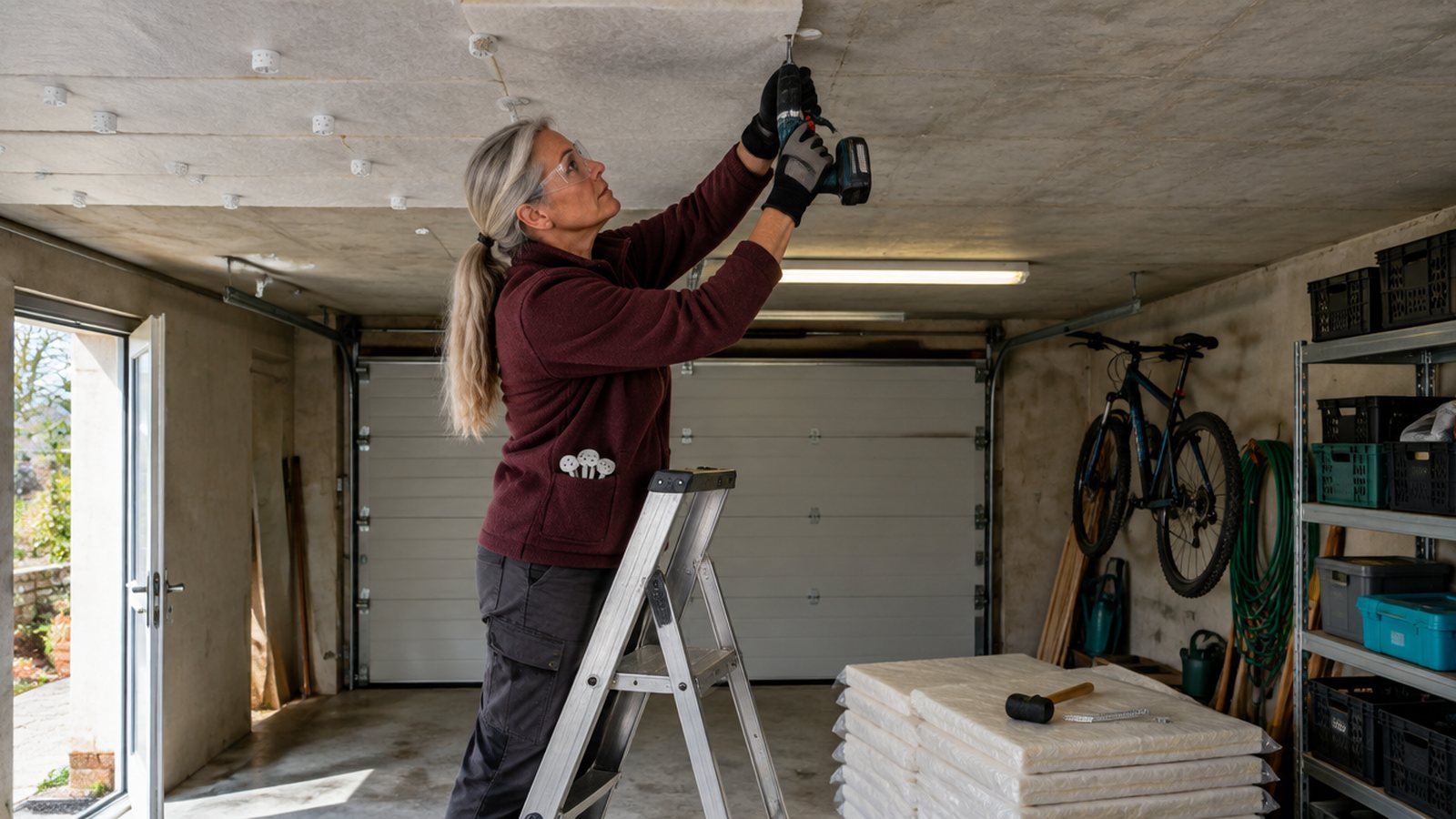
- Stone wool. Non-combustible. Boards are glued and often fixed with dowels as well. Some boards have a white finished face and need no further treatment.
For a garage ceiling, stone wool is the better choice because it does not burn. For public garage ceilings, non-combustible insulation is also a legal requirement.
How thick should the insulation be
One insulation manufacturer gives a simple rule. If the floor above already has about 5 cm of insulation, add at least 10 cm to the underside of the basement ceiling.
Before you decide on thickness, measure the basement height. Thicker insulation means a lower ceiling. Also check whether doors, windows or stairs sit close to the ceiling. Tradespeople usually use thinner boards there or cut them around the frames.
How a basement ceiling is insulated
The job is simpler than facade insulation. It is done indoors, without scaffolding and without a render coat at the end, so it can be done in winter too.
- Prepare the ceiling. It must be solid, dry and clean. Loose plaster, dust and flaking paint have to come off.
- Deal with services. Pipes, cables and lights on the ceiling decide where and how boards are cut.
- Glue the boards. Adhesive goes on the board, and boards are laid tight together, offset by half a board in the next row.
- Fix with dowels where the material needs it. Stone wool is heavier, so it is usually dowelled as well.
- Close the joints. There should be no gaps between boards. Cut boards neatly along walls and around pipes.
If you want to turn the basement into a usable room, you can add a plasterboard lining over the insulation. Lining prices are in the guide Knauf drywall cost per m².
What to check before insulating the ceiling
- Damp in the basement. If walls or the ceiling are damp, fix the cause first. Insulation will not fix damp, and it can hide it. Prices are in the guide waterproofing cost per m². How to tell where the damp comes from is explained in the guide damp basement.
- Pipes in the basement. Once the ceiling is insulated, less heat reaches the basement from the house. The basement can get colder in winter than before. Protect water pipes along outside walls in time; see how to stop water pipes freezing.
- Lights and cables. Light fittings sit lower after insulation. Agree with the tradesperson who handles that.
- Garage and boiler room. Choose non-combustible stone wool there.
- Ventilation. Do not block basement ventilation openings.
- Protection. When cutting stone wool or drilling concrete overhead, wear goggles, a mask and gloves.
Example: insulating a 60 m² basement ceiling
This is a made-up example, for orientation only. Say you have a house with a basement under the ground floor. The basement ceiling is a 60 m² concrete slab, the basement is dry, and the pipes run along the walls.
| Item | Calculation | Approx. (€) |
|---|---|---|
| Basement ceiling insulation, complete (boards + adhesive + labour) | 60 m² × 18–25 € | ~1,080–1,500 |
| Moving lights, extra pipe protection | per quote | — |
| Total (excl. extra work) | ~1,080–1,500 |
If you choose stone wool or XPS instead of EPS, expect more. The 10 cm boards alone for 60 m² cost about 850 €.
If you do everything yourself, 10 cm EPS for 60 m² costs about 360–480 € at retail prices. Adhesive adds around a hundred euros, and dowels a little more.
Questions to ask before you agree on the job
- Is the price per m² labour only or with materials?
- Is VAT included?
- Which material, and how thick are the boards?
- Are the boards only glued, or dowelled as well?
- Who cuts and fits boards around pipes, cables and lights?
- Is ceiling preparation included?
- Who moves the light fittings?
- Who removes waste and packaging?
- How long is the warranty on the work?
Compare at least two or three quotes with the same items. The lowest price per m² often means thinner boards or something left out.
When to call a tradesperson through Gigron
You can glue EPS to a dry, flat concrete ceiling yourself if you have a stable work platform or ladder and someone to help. Working overhead is tiring. With stone wool, a damp basement, lots of services or a garage, it is better to call a tradesperson.
On Gigron, look at the facades category, because facade installers work with the same boards, adhesive and dowels. If you are in Zagreb, see facades in Zagreb. There are also facades in Rijeka and facades in Pula. For ceiling preparation and small repairs see masonry work, and if a lining goes over the insulation, see drywall.
If it is also cold under the roof, prices are in the guide attic floor insulation cost per m². For wall insulation see facade insulation cost per m².
How to write a good request on Gigron
The clearer the request, the faster you get quotes you can compare. Include:
- ceiling area in m²,
- basement or garage height,
- ceiling type: concrete slab, brick or timber,
- any damp in the basement,
- what is on the ceiling: pipes, cables, lights,
- preferred material and thickness, if you already know,
- city and timing that suit you.
Add photos of the ceiling and services. More tips are in the guide how to write a request to a tradesperson.
Example request (made up): "I need insulation for a basement ceiling of about 45 m² in a house. The ceiling is concrete, 2.4 m high, and the basement is dry. There are two pipes and three lights on the ceiling. I would like 10 cm EPS or stone wool. Please quote with VAT, labour and materials separately. Karlovac, November works for me."
Find a tradesperson for basement ceiling insulation on Gigron
On Gigron you post a request and local tradespeople reply with quotes. It is free and you do not have to call ten numbers. Give the m², ceiling height and city to get clear answers faster.
Download the app:
Frequently asked questions
Can a basement ceiling be insulated in winter?
Yes. The work is done indoors, so the weather outside does not matter. Board adhesive usually needs at least +5 °C in the room and on the surface. In a very cold basement that means a little heating until the adhesive sets.
Is basement ceiling insulation worth it?
If the ground floor is cold underfoot in winter, it usually is. The job is simpler and cheaper than a facade. The heating saving is smaller than with a facade or attic, but the floor feels noticeably warmer.
Which is better for a basement ceiling: EPS or stone wool?
For a dry basement under the house, EPS is the cheapest and perfectly adequate. For a garage, a boiler room, or if non-combustible insulation matters to you, choose stone wool. If the basement is on the damp side, ask about XPS.
In short: basement ceiling insulation cost in Croatia in 2026 is roughly 18–25 € per m² for a complete job, and labour alone about 10 € per m² excl. VAT. Small ceilings, stone wool and lots of services push the total up. So ask for a quote per m² and in total, with material, thickness and every item listed.