Draught-proofing doors for winter in Croatia: stop the draught
The heating is on, the windows are shut, and you still feel cold air along the hallway floor? Often the doors are to blame. Draught-proofing doors is one of the cheapest jobs before winter. A self-adhesive seal and a brush strip under the door cost a few euros, and the draught drops the same day.
In this guide you will learn how to find where the air gets in, which seal to choose, how to seal the front door of a flat or a house, when a door needs adjusting and why some doors must not be sealed completely. At the end you will find approximate prices, an example and a checklist for your request.
Draught-proofing doors: where the draught comes from
Before you buy a seal, check where the air actually gets through. Usually it is one of four places:
- Under the door. There is a gap of a few millimetres up to two centimetres between the leaf and the floor. On a flat's front door, cold air from the stairwell comes in through it.
- Along the frame. The leaf does not press against the frame because there is no seal, or the old one has hardened or flattened.
- The leaf is not straight. The door has dropped on its hinges, or the lock keeper does not hold the leaf tightly enough. It blows in one place and catches in another.
- Between the frame and the wall. A crack, loose plaster or old expanding foam. Seal tape will not fix this; it is a job for a tradesperson.
If it blows in several places, start with the biggest gap. That is usually the threshold.
How to find a draught around a door
It is easiest to check on a cold, windy day.
- Your hand. Run your palm slowly along the edge of the closed door, from top to bottom. You will feel cold air straight away.
- The paper test. Put a sheet of paper between the leaf and the frame, close the door and pull. If the paper slides out easily, the leaf does not seal there. Repeat by the hinges, by the lock and at the top.
- Light. In the evening, switch on the light on one side of the door and turn it off on the other. Every line of light around the leaf is a place where air gets through too.
- Measure the gap under the door. Check in several places. Floors are often not level, so the gap is not the same everywhere.
- Look at the old seal. If it is hard, cracked or permanently flattened, a new seal will help more than adjusting.
- Check how it closes. If you have to push the door to lock it, or the handle sticks, the problem is in the hardware, not just the seal.
Which door seal: tape, brush or drop-down seal
The choice depends on how big the gap is and where it is. Approximate 2026 prices from Croatian shops (VAT included):
| Type | Where it goes | Gap size | Approximate price |
|---|---|---|---|
| Self-adhesive rubber tape, E profile | on the frame, along the leaf | about 1–3.5 mm | about €2–4 for 6 m |
| Self-adhesive rubber tape, P profile | on the frame, along the leaf | up to about 5 mm | about €2–4 for 6 m |
| Thicker rubber tape, D profile | on the frame, along the leaf | somewhat larger gaps | about €5–10 for 6 m |
| Self-adhesive brush strip for under the door | on the bottom edge of the leaf | up to about 15–22 mm, depending on the model | about €9–18 per piece (1 m) |
| Drop-down (automatic) seal | fitted into a groove at the bottom of the leaf | drops when you close the door | about €20–45, special models more |
A few tips for choosing:
- Take the measurement to the shop. A seal that is too thick stops the door from closing; one that is too thin does not seal.
- Brush strips are for smooth floors. They glide well on tiles, laminate and parquet. For carpet, look for a model that says so explicitly.
- A drop-down seal is the neatest. It is hidden and does not scrape the floor because it only drops when the door closes. It needs a groove routed into the leaf, so it is a job for a carpenter or door specialist.
- A draught stopper cushion in front of the door is the quickest fix for interior doors, but it only works while it stays in place.
How to seal a door with a self-adhesive seal
You do not need special tools for self-adhesive tape and brush strips. A tape measure, scissors or a craft knife and a cloth are enough.
- Clean and degrease the frame. Dust and grease are the main reason tape comes off. Let the surface dry completely.
- Work in a warm room. The adhesive holds better on a warm, dry surface. If it is cold outside, stick the tape on the inside and wait for the frame to warm up.
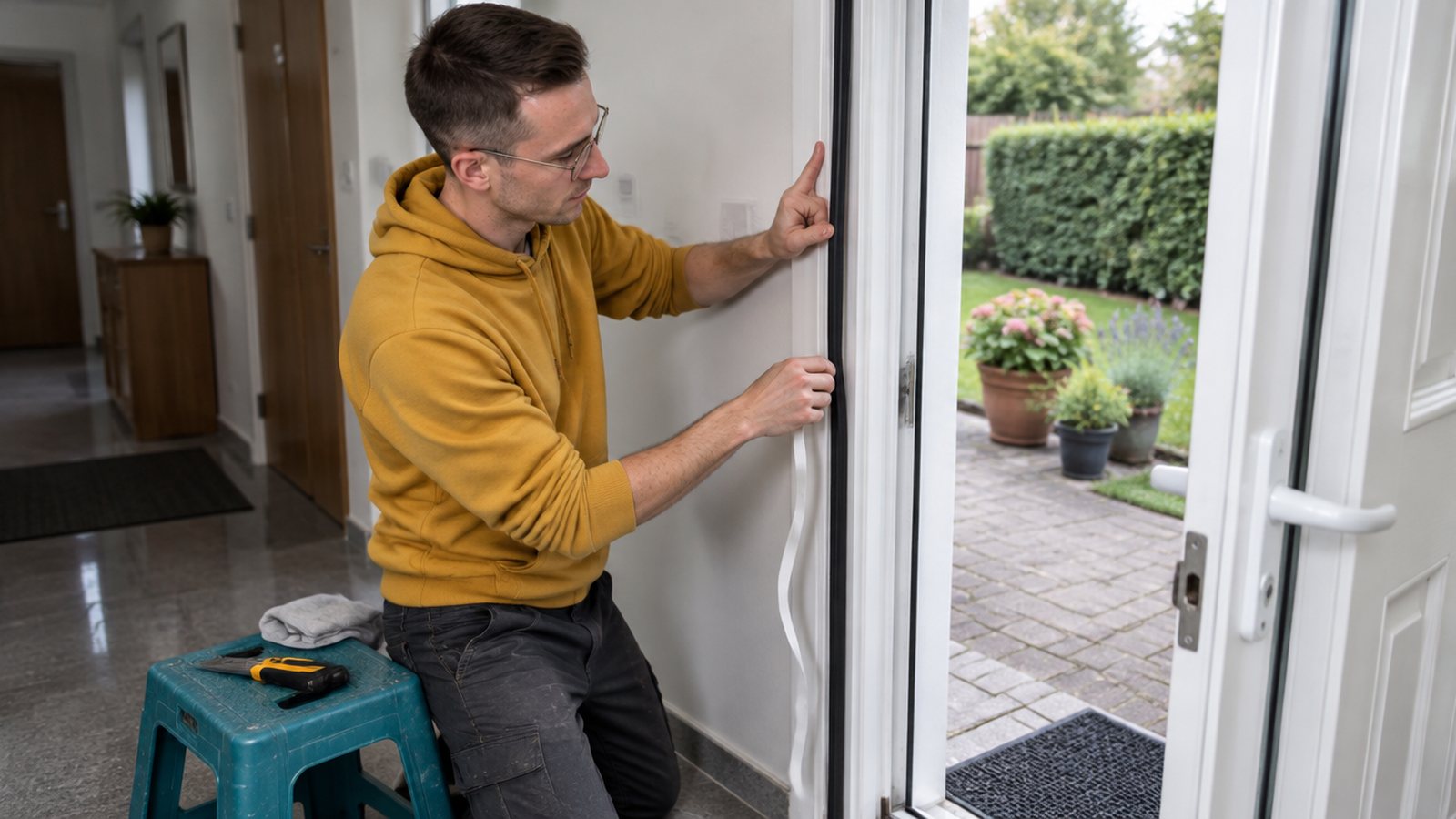
- Start from the top corner. Peel the backing off bit by bit and press the tape down with your finger. Do not stretch it, because stretched rubber shrinks back later.
- Cut the corners accurately. The ends must touch, otherwise a gap remains in the corner.
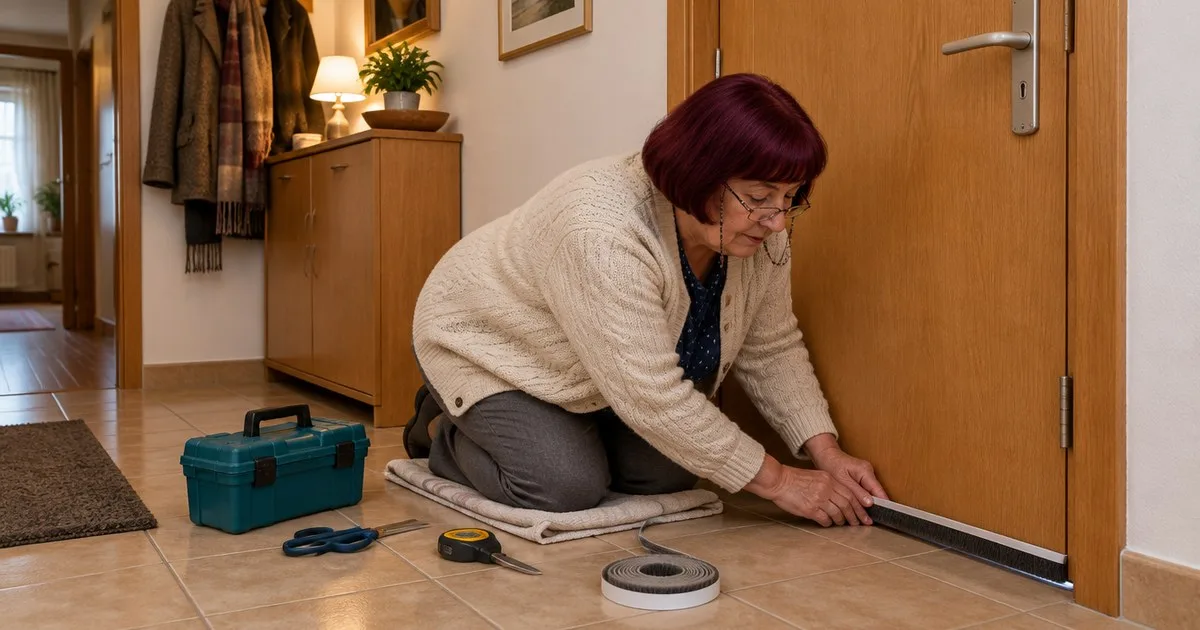
- Fit the brush strip with the door closed. Hold it against the floor so the bristles lightly touch it, mark the height and only then stick it on.
- Check that it closes. The door must close and lock without pushing. If it does not, the tape is too thick.
- Repeat the paper test. The paper should now pull out with resistance all the way round.
The seal on the hinge side wears less but gets squeezed harder. If the door is hard to close right by the hinges after sealing, use a thinner profile there.
Sealing the front door of a flat or a house
Old wooden front doors in apartment buildings
In older buildings, a flat's front door often has no groove for a seal. Self-adhesive tape on the frame and a brush strip on the bottom edge of the leaf work best here. If the leaf is warped and the gap along the frame is more than a few millimetres, even the thickest seal will not help much. Then it is worth thinking about a new door. Prices are in our guides entrance door cost and security door cost with installation.
PVC and aluminium front doors on houses
PVC and aluminium doors have a rubber seal in a groove on the leaf and the frame. Do not stick new tape over it. When it hardens or cracks, the original profile is replaced all the way round. Cut off a piece of the old seal and take it to the shop or show it to the tradesperson.
Once a year, wash rubber seals with mild soapy water, dry them and treat them with silicone spray. That keeps them soft for longer.
Adjusting a PVC front door
If the seal looks fine but the door still lets in a draught or sticks, the problem is in the hardware. PVC front doors are heavy, and PVC expands and shrinks with temperature changes. Over the years screws work loose and the leaf drops. Adjusting a PVC front door means adjusting the hinges, the lock keepers and the bolts of the security hardware.
Front doors have a lot of screws, so they are not easy to adjust without experience. You can easily end up with a door that will not lock. It is better to leave this to a tradesperson. You can lubricate the hinges and the lock yourself and clean the seals regularly. Balcony doors are adjusted much like windows, as described in our guide adjusting PVC windows for winter.
Careful: doors, gas boilers and bathrooms
This is the part people skip most often, and it is the most important.
If your flat has an open-flue (atmospheric) gas boiler, it takes combustion air from the room and the flue gases go into the chimney. According to guidance from Gradska plinara Zagreb, the door of the room with such a boiler (usually the bathroom) must have ventilation openings at the top and bottom, and all doors in the flat must be trimmed by about 2 cm at the bottom. Without enough air, flue gases can flow back into the room and cause carbon monoxide poisoning.
So:
- do not fit a brush strip or seal under the doors in a flat with an open-flue gas boiler,
- do not cover the grilles in bathroom or kitchen doors,
- before sealing doors or windows, ask a certified gas appliance technician whether it is safe for your appliance.
If you do not know what kind of boiler you have, ask at the next service. What gets checked is in our guide gas boiler service cost.
Even without gas, bathrooms and kitchens need fresh air. When you seal the whole flat tightly, steam has nowhere to go, so condensation on windows and mould in corners appear more easily. Air the rooms briefly several times a day; there is more on this in our guide condensation on windows.
How much does door draught-proofing cost with a tradesperson
Approximate prices from public price lists and example requests in Croatia in 2026:
| Service | Approximate price |
|---|---|
| Self-adhesive seal and brush strip, materials only | usually under €30 per door |
| Replacing the original seal on a PVC or aluminium door | about €15–30 per running metre |
| Adjusting the hardware | about €45 with some providers |
| Sealing an aluminium front door (public request, Zagreb) | roughly €90–150 |
| Drop-down seal | about €20–45 for materials, plus routing the groove and fitting |
Some providers charge a minimum call-out fee. If the window seals also need replacing, it pays to do everything in one visit.
Example (made up): a PVC front door on a house, leaf about 90 × 210 cm. The perimeter of the leaf is about 6 m. Replacing the seal at €15–30 per metre comes to about €90–180, and if the hardware needs adjusting too, add about €45. If you seal the same door with self-adhesive tape and a brush strip, the materials are usually under €30, but that only makes sense if the original seal does not need replacing. You get the final price only after an inspection.
What to check before sealing a door
- A gas boiler in the flat. If it is an open-flue type, do not seal under the doors and do not cover the openings. Ask the technician.
- The door must close easily. A seal that is too thick strains the lock and the hinges, and the lock becomes hard to turn.
- Do not stick tape over the original seal on PVC and aluminium doors. Remove the old one and fit the same profile.
- The floor is not level. A brush that scrapes at one end will not touch the floor at the other. Measure the gap in several places.
- Front doors in apartment buildings. If you are replacing the leaf or the frame, not just the seal, check with the building manager whether there are rules for how doors facing the stairwell should look.
- Draughts around the frame. If air comes in between the frame and the wall, seal tape will not help. You need a tradesperson.
What to fix yourself and when to call a tradesperson
| Problem | What to do |
|---|---|
| Gap under interior doors, no gas boiler | Self-adhesive brush strip or draught stopper cushion |
| Draught along the frame of an old wooden door | Self-adhesive tape, E or P profile depending on the gap |
| The original seal on a PVC or aluminium door has cracked | Tradesperson, or the same profile from a shop all the way round |
| The door sticks, is hard to lock or has dropped | Tradesperson: adjusting hinges and hardware |
| Draught between the frame and the wall | Tradesperson: sealing the joint, foam and plaster |
| You want a neat, hidden seal under the door | Tradesperson: drop-down seal in a groove |
If the door still lets in a draught after a new seal and adjustment, and the leaf is warped or cracked, it is worth asking for a quote for a new door. Interior door prices are in our guide interior doors cost with installation. Other autumn jobs are in our preparing your home for winter checklist.
How to write a good request on Gigron
Include:
- which door: flat front door, house front door, balcony or interior door,
- what it is made of: wood, PVC or aluminium, and roughly how old it is,
- where it blows: under the door, along the frame, by the hinges or around the frame,
- what else is happening: the door sticks, is hard to lock, the seal has cracked,
- whether you have a gas boiler in the flat or house,
- city, neighbourhood, floor and when suits you.
Add photos of the bottom edge of the door, the seal up close and the hinges. If you are not sure what to write, our guide how to write a request to a tradesperson will help.
Example request (made up): "In my house in Velika Gorica I have a PVC front door that is about 15 years old. It blows along the bottom edge and by the hinges, and the lock is harder to turn in winter. The seal has cracked in a few places. I need the door adjusted and a quote for a new seal. The gas boiler is a condensing one, in the boiler room. Next week, in the morning, works for me."
On Gigron, see the doors category. You can also find door professionals in Zagreb.
Find a tradesperson for door draught-proofing on Gigron
On Gigron you post a request and local professionals reply with offers. It is free and you do not have to call ten numbers.
Download the app:
Frequently asked questions
Is a gap under the door allowed?
It is, and sometimes it is required. In a flat with an open-flue gas boiler, doors must be trimmed at the bottom so air can reach the boiler. In a flat without gas, a gap under interior doors helps air move between rooms. Seal the front door first, and doors to unheated spaces such as a stairwell, garage or basement.
How long does a self-adhesive seal last?
It depends on the material and how often the door is opened. Makers of rubber tapes state a lifespan of up to about 8 years, and brush strips about 6 years. On a front door that opens every day, the seal wears faster. When it hardens or comes unstuck, replace it.
What if the seal will not stick because it is cold outside?
Adhesive holds poorly on a cold, damp surface. Stick it on the inside once the frame has warmed up, and clean the surface well. If the door leads straight outside and winter has already arrived, fit the seal on the first milder day, and use a draught stopper cushion until then.
In short: start draught-proofing doors with the hand and paper tests. Put a brush strip under the door, self-adhesive tape of the right profile along the frame, and replace the original seal on PVC and aluminium doors. If the door sticks or is hard to lock, call a tradesperson to adjust it. In a flat with an open-flue gas boiler, do not close the gap under the doors or the openings in them.