Gas combi boiler leaking water: pressure, safety valve and causes
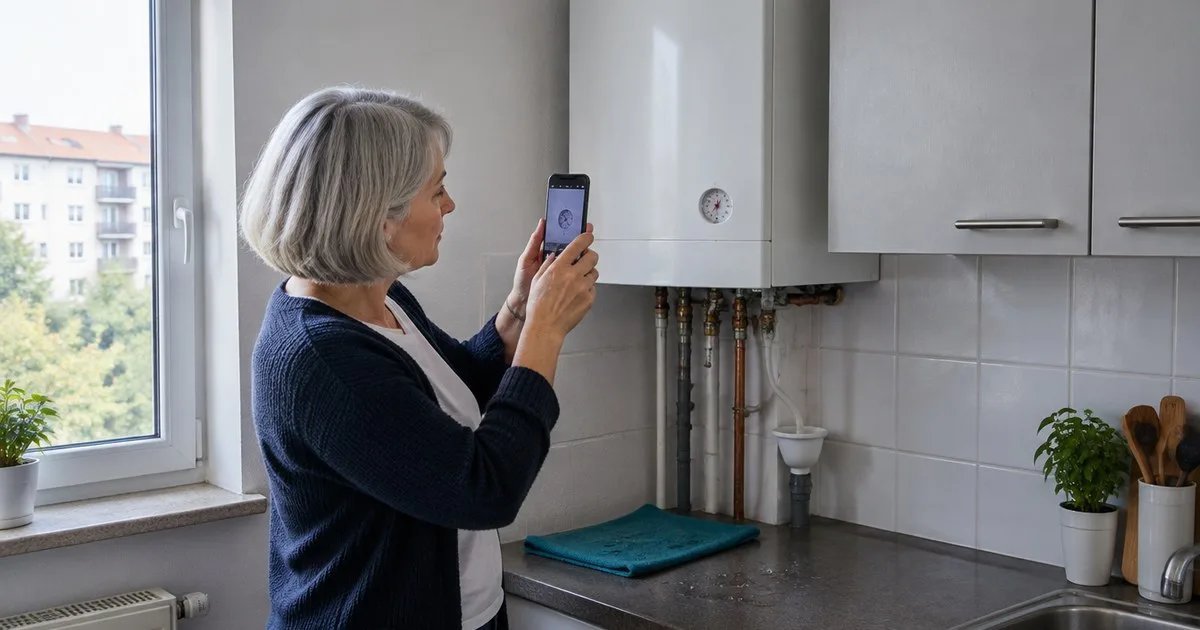
Your wall-mounted gas boiler is running and there is water under it? When a gas combi boiler is leaking water, the boiler itself is usually not the cause. The pressure in the heating system is. So look at the pressure gauge first. In a minute it tells you whether the safety valve has opened, whether the expansion vessel has lost its air, or whether something is really leaking.
This guide is for the gas combi boiler, the wall-mounted unit that heats both the radiators and your tap water, found in most flats in Croatian apartment buildings. The examples come from Vaillant's manuals for the turboTEC pro, but the logic is the same for other brands. If you have an electric water heater in the bathroom, see the guide water heater safety valve dripping.
Safety first. A gas boiler is a gas appliance. Do not take off the casing and do not touch anything inside. If you smell gas, do not light anything, do not switch on lights, and do not use switches or your phone inside the flat. Open the windows, close the gas valve if you can reach it easily, go outside and call the gas distributor's emergency line from there.
Gas combi boiler leaking water: check the pressure first
A combi boiler has two water circuits. One is the hot water for your taps. The other is the closed heating circuit, the water that flows through the radiators. Almost every leak problem on a gas boiler is linked to that second circuit and its pressure.
What pressure is normal? Vaillant's turboTEC pro manual gives a fill pressure of 1.0 to 2.0 bar. Newer manuals for the atmoTEC and turboTEC say 0.8 to 2.0 bar is fine and that you should top up below 0.8 bar. Vaillant's Slovenian advice page says a cold system should normally read 1 to 1.5 bar. While the boiler is heating, the pressure rises a little, but it should stay below 2.5 bar.
The boiler's rating plate also shows the maximum permitted heating pressure, for example 3 bar. The heating safety valve reacts at that limit. Vaillant's replacement 3 bar safety valve for wall-mounted boilers is set to exactly that value. When the pressure reaches it, the valve releases water to protect the boiler and the pipework.
| What the gauge shows | What it usually means | What to do |
|---|---|---|
| About 1–1.5 bar cold, up to about 2 bar while heating | all is well | nothing |
| Below 0.8 bar cold | too little water in the system | top up as the manual says, then watch the pressure |
| Jumps towards 2.5–3 bar when heating, drops low when cold | the expansion vessel is not working properly | call a service engineer |
| Above 2.5 bar cold and rising even when the boiler is off | mains water is getting into the heating | close the filling valve, call a service engineer |
| Pressure keeps dropping and you keep topping up | water is leaving the system somewhere | find the leak, call a service engineer |
Need someone for this job? Describe it and get quotes →
Where exactly is the water coming from
First find where the first drop forms. Water often runs down the pipes, so it looks like it comes from one place when it comes from another.
| Where you see water | Possible cause | What to do |
|---|---|---|
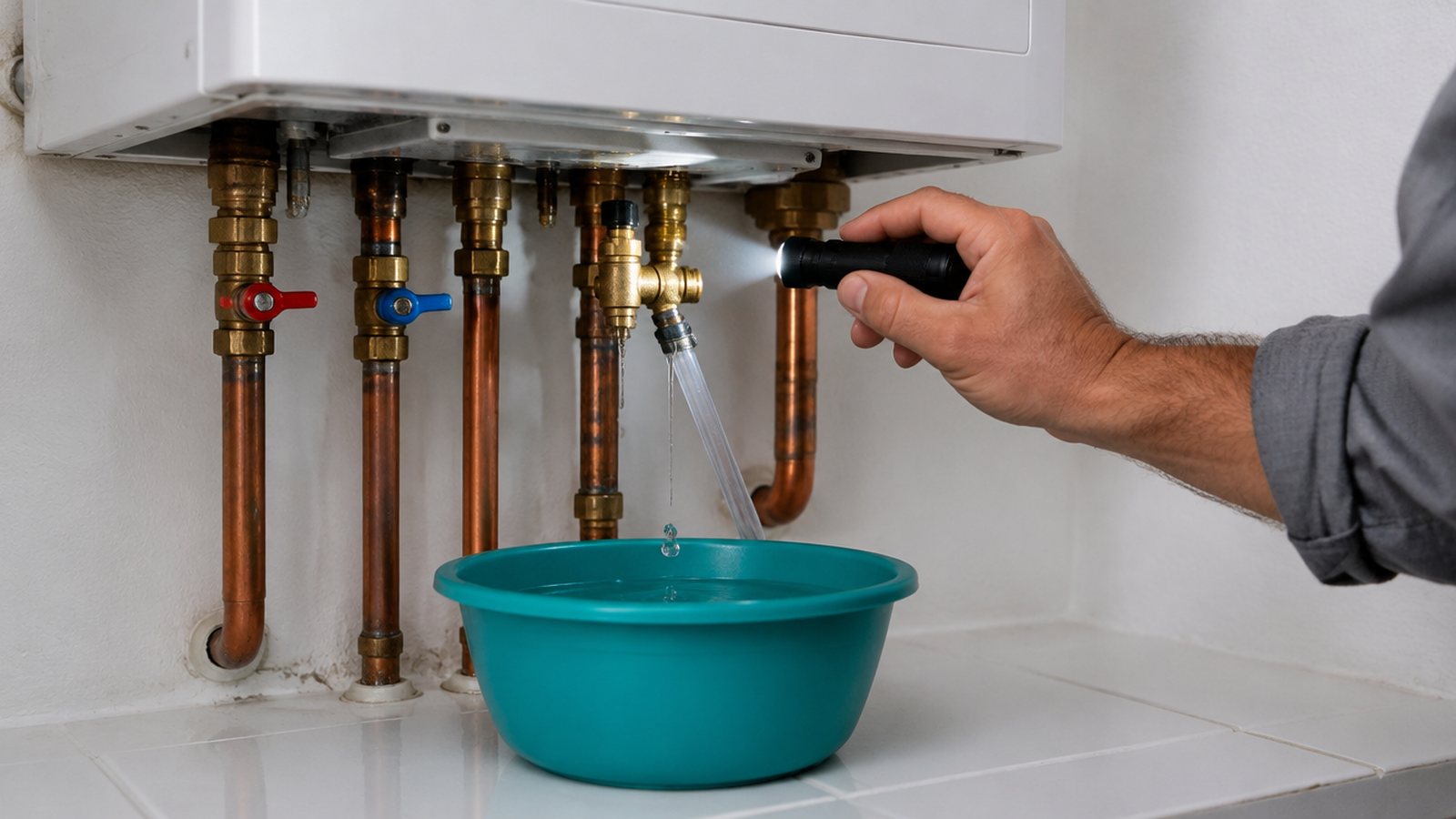
| From the pipe or funnel under the boiler, with pressure near 3 bar | the safety valve opened because the pressure is too high | find the cause of the high pressure, do not just replace the valve |
| From the safety valve while the pressure is normal | the valve no longer seals | valve replacement by an engineer |
| From a pipe joint under the boiler, with white or greenish deposits | the joint or its seal is leaking | an engineer or plumber tightens the joint or replaces the seal |
| From inside, dripping from the bottom of the casing | an internal part, such as the pump, air vent or heat exchanger | switch the boiler off, call an authorised service |
| On the floor or wall away from the boiler | a pipe, radiator or radiator valve | see the guide on pipe leaks below |
If there is a damp patch on the wall, but the boiler and the pipes under it are dry, the problem may be a pipe in the wall. See the guide burst pipe in the wall.
If you have a condensing boiler, water normally runs from it through the condensate pipe into a drain. Vaillant notes that condensing boilers need a drain connection for this reason. If that water leaks next to the pipe or down the wall, call a service engineer.
The most common causes of a gas combi boiler leaking water
The expansion vessel has lost its air
Water expands when heated. In a closed heating circuit the extra water goes into the expansion vessel. Inside it a rubber membrane has water on one side and air under pressure on the other. Vaillant's installation manual for the turboTEC pro lists a built-in 6-litre vessel with a 1 bar pre-charge.
Over time the vessel loses air. One Croatian boiler service company describes it as a vessel that has “drunk the water”. The extra water then has nowhere to go. The pressure shoots up while the boiler heats, the safety valve releases water, and when the system cools the pressure falls below 1 bar. You top up and the cycle starts again.
If this happens to you, the safety valve is usually fine and doing its job. The vessel is the problem. An engineer checks and resets the vessel's pre-charge or replaces it. Checking the expansion vessel pre-charge is also on Vaillant's list of maintenance tasks.
Too much water, or the filling valve left open
Vaillant says high pressure is often caused by an overfilled system. That happens when you top up too much or when the filling valve stays slightly open after topping up. Mains water then slowly enters the heating and the pressure rises even when the boiler is off.
That is why the last steps in Vaillant's topping-up instructions are: close the filling valve and disconnect it from the cold water line. Check that the valve is fully closed. Do not force it.
The hot water heat exchanger is leaking internally
A combi boiler has a small plate heat exchanger. Mains water flows on one side and heating water on the other. One British gas engineering firm explains that mains water can cross into the heating when the wall between them fails. The pressure then rises even though nobody touches the filling valve.
How is this different from an open filling valve? The engineer closes or disconnects the filling link and watches the pressure. If it still rises, the heat exchanger is the suspect. This is a job for an authorised service.
The safety valve no longer seals
Vaillant says a blocked or damaged safety valve does not work properly and that a leaking valve may be a sign it needs replacing. If the valve drips while the pressure is normal, it probably does not seal. Replacing it is a simple job for an engineer, but the valve must match your boiler.
According to Vaillant's instructions, the safety valve outlet must have a drain pipe with a funnel and a trap, and that drain must be visible. That way you notice straight away when the valve opens.
A joint or seal is leaking
There are several joints under the boiler: gas, heating flow and return, cold and hot water. A leaking joint usually drips slowly and leaves white or greenish deposits. If it is a water joint under the boiler, an engineer or plumber tightens it or replaces the seal. Never touch the gas connection.
Boiler pressure keeps dropping: where does the water go
If you keep topping up, the water is leaving somewhere. The most common places are:
- the safety valve, when the pressure jumps during heating because of the expansion vessel; check whether the funnel or pipe under the boiler is wet,
- radiators and radiator valves, check the joints and the floor under them,
- bleeding radiators, because when you let air out, a little water comes out too and the pressure drops,
- pipes in the floor or wall, if you see no water anywhere but the pressure keeps falling.
How to bleed radiators properly and how much the pressure drops afterwards is explained in the guide radiator not heating.
If the pressure falls below 0.5 bar, Vaillant's newer manuals say the boiler shows a fault. For lack of water the display shows F.22. One Croatian service company warns that constant topping up is not a fix, it only hides the real cause.
What you can do yourself
This is everything you may do without an engineer. None of it involves removing the casing.
- Put a bowl or cloth under the drip and wipe up the water. If water is running towards the electronics or a socket, switch the boiler off.
- Write down the pressure in the morning while the system is cold, and again while the boiler is heating. Photograph the gauge both times.
- Check the filling valve. It must be closed. If it was open, close it and watch the pressure the next day.
- If the cold pressure is below 0.8 bar, top up as your boiler's manual says. On a Vaillant you open the valve slowly up to the required pressure, close it, bleed the radiators and check the pressure again. The first fill is done by an authorised engineer.
- Look at the funnel or pipe under the safety valve. Wet means the valve has opened.
- Call a service engineer and send photos, the boiler model and the pressures you wrote down.
Water from the heating and from the valve can be hot. Keep your hands away from the outlet.
What you must never do
- Do not take off the casing or repair anything inside. Vaillant's manual says you must not repair or service the boiler yourself. Faults and damage are fixed by an authorised engineer.
- Do not plug the safety valve or its drain. Vaillant forbids any changes to the safety valve and drain lines.
- Do not pump up the expansion vessel yourself. The engineer recharges it with the boiler drained and the pressure measured.
- Do not top up day after day without looking for the cause. You keep adding fresh mains water, and Vaillant warns that unsuitable water damages seals and clogs parts of the boiler.
- Do not add antifreeze or anti-corrosion products to the heating. Vaillant warns they can damage the seals.
- Do not touch the gas connections or the gas valve.
What a repair costs
This is not a price guide, but it helps to know the range. Prices are from public price lists of Croatian gas boiler service companies and online shops, checked on 4 November 2026, VAT included.
| Service or part | Approximate price | Note |
|---|---|---|
| Call-out and diagnosis | about €33–76 | three Croatian gas services, the highest includes inspection and adjustment |
| Checking and recharging the expansion vessel | about €90 | one price list |
| Replacing the expansion vessel with the boiler taken down | about €100–191 | labour, vessel not included |
| Replacing a part on the water assembly | about €81 | labour, part not included |
| 3 bar safety valve, ½″ | about €6–9 | generic valve in Croatian online shops |
| Original Vaillant 3 bar valve | about €34–38 | for some models, German online shops |
Which valve goes into your boiler is up to the engineer, based on the model. For the cost of a regular service, see the guide gas boiler service cost. Vaillant recommends an inspection every year and maintenance every second year.
When to call a service engineer straight away
Call an authorised service if:
- you smell gas, and only after you are outside,
- water is dripping from the boiler casing or onto the electronics,
- the pressure reaches 3 bar while heating or the safety valve releases water,
- the pressure rises even when the boiler is off,
- you need to top up more often than once every few weeks,
- the display shows a fault, such as F.22, that does not clear after topping up.
You can find heating engineers in the heating category, and in Zagreb on the heating in Zagreb page. For boilers, see boilers and boilers in Zagreb. If water has already damaged the floor or ceiling, there is leak repair.
How to write a request on Gigron
The more details you give, the faster you get an accurate quote. Include:
- the boiler brand and model, from the rating plate or the front panel,
- the pressure cold and while heating,
- where exactly it leaks: from the safety valve pipe, a joint or the casing,
- how often you top up,
- the fault code on the display, if there is one,
- when it was last serviced,
- your city and preferred dates.
Add photos of the pressure gauge and the leak. For more tips, see the guide how to write a request to a tradesperson. How the warranty on completed work applies is explained in the guide warranty on building work.
Example request (made up): “Vaillant turboTEC pro in a flat. Cold pressure is about 1 bar, while heating it goes up to 3 bar and water drips from the pipe under the boiler. I top up every week. Please check the expansion vessel and safety valve. Zagreb, Trešnjevka, this week.”
Find a service engineer on Gigron
On Gigron you post a request and local tradespeople reply with quotes. It is free and you do not have to call ten numbers. Write what the pressure gauge shows and add a photo, and you will get clear answers faster.
Download the app:
Frequently asked questions
What should the pressure be on a gas boiler?
On most combi boilers about 1 to 1.5 bar when the system is cold. Vaillant gives 1.0 to 2.0 bar for the turboTEC pro. While the boiler heats, the pressure rises a little, but according to Vaillant it should stay below 2.5 bar. Check your boiler's manual for the exact value.
Should the safety valve on a gas boiler drip?
Not in normal operation. That is the difference from an electric water heater, where dripping while heating is normal. On a gas combi boiler the valve opens only when the pressure gets close to 3 bar. If it drips, the pressure is too high or the valve does not seal.
Why does the pressure keep dropping on my gas boiler?
Most often because water escapes through the safety valve when the pressure jumps during heating, which usually means the expansion vessel lacks air. Other reasons are leaks on radiators or pipes and bleeding the radiators.
Can I top up the water in my boiler myself?
Yes, if your boiler's manual says so. Vaillant's user manual explains how to top up. If you have to do it often, do not just keep topping up, call a service engineer.
In short: when a gas combi boiler is leaking water, check the pressure first. If it climbs to 3 bar while heating, the safety valve is just doing its job, and the cause is usually the expansion vessel, an overfilled system or mains water getting in. If the boiler pressure keeps dropping, water is leaving somewhere. Do not remove the casing, do not plug the valve, and call an authorised service.
Need someone for this job?
Add the details, for example where and by when.
The AI assistant writes the post; you post it in the Gigron app.