Radiator not heating? How to bleed a radiator, step by step
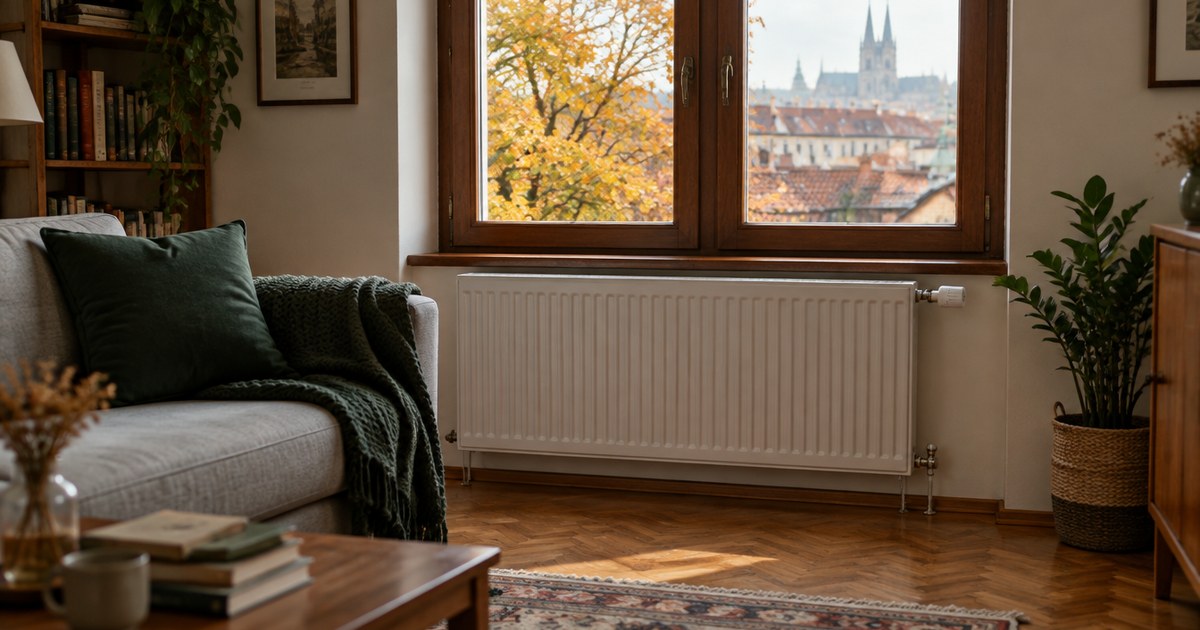
You turn the heating on and one radiator is not heating. Or it is warm at the top and cold at the bottom. The good news: you can often fix it yourself in about ten minutes by bleeding the radiator and checking the pressure on your boiler.
This guide shows you step by step how to bleed a radiator, how to spot the cause from where the radiator is cold, and when it is time to call a tradesperson.
Why is my radiator not heating? Quick diagnosis
First, feel the radiator from top to bottom and check the pipes. Where it is cold usually tells you the cause.
| What you notice | Most common cause | What to do |
|---|---|---|
| Cold at the top, warm at the bottom | Air in the radiator | Bleed the radiator |
| Hot at the top, cold at the bottom | Sludge and deposits at the bottom | Flushing (tradesperson) |
| Pipes warm, radiator cold | Stuck thermostatic valve | Free the valve pin |
| Last radiator on the circuit barely warm | System not balanced | Balancing (tradesperson) |
| All radiators cold | Boiler, pressure, pump or district heating | Check the boiler, call a technician |
| Gurgling and rushing noise in the pipes | Air in the system | Bleed and check pressure |
If your radiators are not heating evenly, start with the simplest things: bleeding and pressure.
What you need to bleed a radiator
- a radiator key (a small square key from any hardware shop; some valves take a flat screwdriver),
- a small container or cup,
- a cloth (one under the valve, one against the wall),
- access to the pressure gauge on your boiler, if you have your own boiler.
How to bleed a radiator: step by step
- Switch the heating off and wait. Once the pump stops, air collects at the top. Wait half an hour to an hour until the radiators are lukewarm.
- Open the thermostatic valves fully (to the highest number).
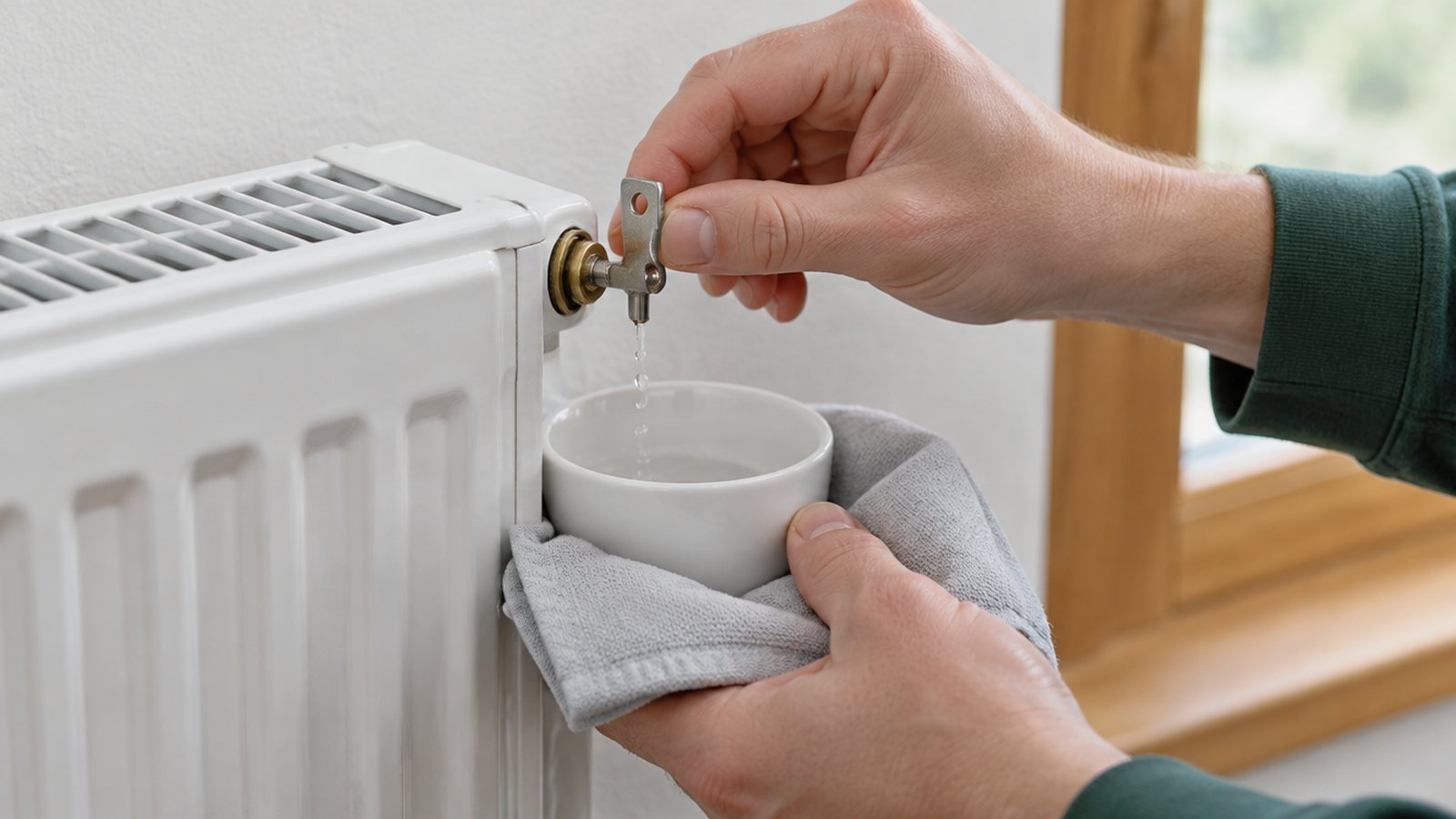
- Find the bleed valve. It is a small round nut with a square slot in the top corner, usually opposite the thermostatic head.
- Put the container and cloth underneath. Hold the second cloth against the wall.
- Slowly turn the key anticlockwise, a quarter to half a turn. You will hear air hissing out. Do not unscrew the valve all the way.
- Close it when water appears. As soon as a steady stream without bubbles comes out, turn the key clockwise. Do not overtighten.
- Repeat on the other radiators.
- Check the boiler pressure and top it up if needed (see below).
- Turn the heating back on and feel the radiators after an hour. If one still gurgles, repeat.
In what order should you bleed radiators?
Start with the radiator furthest from the boiler and work towards it, finishing with the closest one. In a house with several floors, go floor by floor in the same order, and check the top floor again once the system is running, because air likes to collect there.
In a building on district heating (common in Zagreb and other Croatian cities), you do not control the pressure. You can still bleed your radiators with the same key, but work slowly because the water may be hot. If no radiator heats up, or a whole riser is cold, contact the building manager or the district heating company.
What should the boiler pressure be?
Bleeding lets a little water out too, so the pressure drops. On most combi boilers the pressure in a cold system should be around 1–1.5 bar, and it can rise to about 2 bar while the heating runs. Check the exact value in your boiler's manual.
If the pressure is below 1 bar, find the filling tap (usually under the boiler). Open it slowly, watch the needle and close it at about 1.5 bar. Do not overfill, because too much pressure will trigger the safety valve.
If you have to top up the pressure every few days, there is a leak or the expansion vessel is not working properly. That is a job for a service technician. For what an annual service includes and roughly costs, see our guide to gas boiler service cost (in Croatian).
The thermostatic valve is stuck
Pipes next to the radiator are warm, but the radiator stays cold? Under the thermostatic head there is a metal pin that can stick in the closed position over the summer.
- Unscrew the thermostatic head (usually by hand; some have a ring or clip).
- Press the pin with your finger a few times. It should spring back out easily.
- If it is stuck, move it gently with pliers or tap it with a screwdriver handle.
- Put the head back and set the number you want.
If the pin will not move or the valve leaks, the valve needs replacing. Leave that to a tradesperson, as it means draining water.
Radiator cold at the bottom: sludge and flushing
Hot at the top and cold at the bottom? Bleeding will not help. The cause is usually sludge: rust and limescale that build up at the bottom over the years, so hot water only flows through the top.
The fix is flushing the radiator. A tradesperson removes and flushes the radiator, or flushes the whole system with a pump and cleaning agent (worth asking for if several radiators are affected). A magnetic filter in front of the boiler then helps keep sludge from coming back.
All radiators cold? Check the boiler
When the whole flat is cold, the radiators are rarely the problem. Check that the boiler has power and is in winter mode, that the room thermostat works (batteries, set temperature), what the pressure is, and whether there is an error code on the display.
You can reset the boiler once, following the manual. If the error keeps coming back, or the boiler runs but the water does not circulate, the pump may be faulty. Do not open the casing of a gas boiler yourself. At the start of the season it is also worth going through our prepare your home for winter checklist (in Croatian).
Safety first
- Water from a radiator can be very hot. Work slowly and keep your hands out of the stream.
- Do not use pliers or a large spanner on the small brass nut; it is easy to damage.
- If you smell gas, do not touch the boiler. Close the main gas valve, open the windows, do not switch on lights or any switches, leave and call the gas distributor's emergency line or 112.
When to call a tradesperson
Call a tradesperson if the pressure keeps dropping, something leaks, the radiator is still cold at the bottom after bleeding, or the boiler shows an error. The cost depends on the job: replacing a valve is quick, while flushing the system or servicing the boiler takes longer. If the radiator is old, leaking or still heats unevenly after flushing, see radiator replacement cost. You can find tradespeople in the plumbing and heating categories. If you are in Zagreb, see heating in Zagreb and plumbing in Zagreb.
How to write a good request on Gigron
A clear request gets useful replies faster. Include:
- what is happening: which radiator, cold at the top or bottom, since when,
- what you have already tried: bleeding, the reading on the pressure gauge,
- type of heating: your own gas boiler (and its age), pellet boiler or district heating,
- number of radiators, flat or house, floor, any leaks,
- city, neighbourhood and the time that suits you.
Add a photo of the radiator, the valve and the pressure gauge.
Example: “The radiator in the living room is hot at the top and cold at the bottom. I have already bled it, the boiler pressure is 1.4 bar. Gas combi boiler about 10 years old, 6 radiators, flat on the 2nd floor. I need flushing or advice on what to do next. Zagreb, Maksimir. Weekdays after 4 pm suit me.”
Find a heating tradesperson on Gigron
On Gigron you post a job and local tradespeople reply with quotes. It is free and you do not have to call ten numbers.
Download the app:
In short: when a radiator is not heating, feel it first. Cold at the top means air, so bleeding the radiator helps. Cold at the bottom means sludge and flushing. Warm pipes with a cold radiator mean a stuck valve. After bleeding, always check the boiler pressure.