Burst pipe in the wall: how to find the leak and what to do first
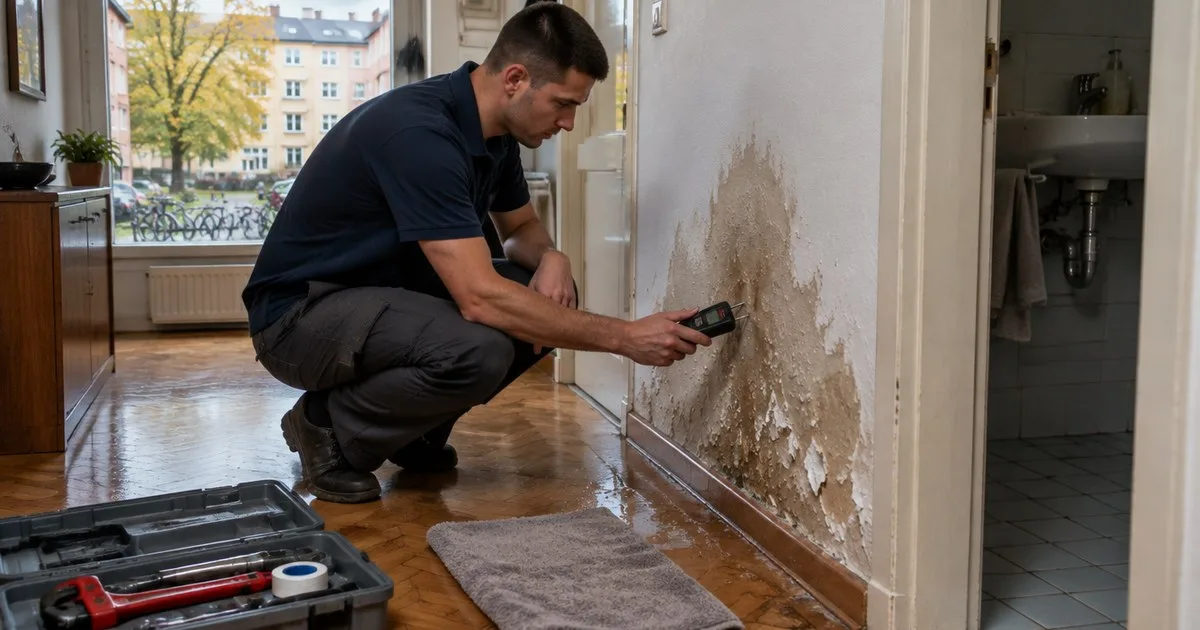
A dark stain has appeared on the wall, the paint is peeling and the water bill is higher than usual? You may have a burst pipe in the wall. A leak like this often stays hidden for days, and all that time the water soaks the plaster, the floor and sometimes the flat below you.
This guide covers what to do straight away, how to find a hidden water leak in a wall with the water meter test, how a plumber traces the fault without tearing out half the bathroom, and who pays for the repair and the water bill. At the end there is an example request for a plumber.
Burst pipe in the wall: what to do right away
If water is coming out of the wall or the stain grows by the hour, do not wait:
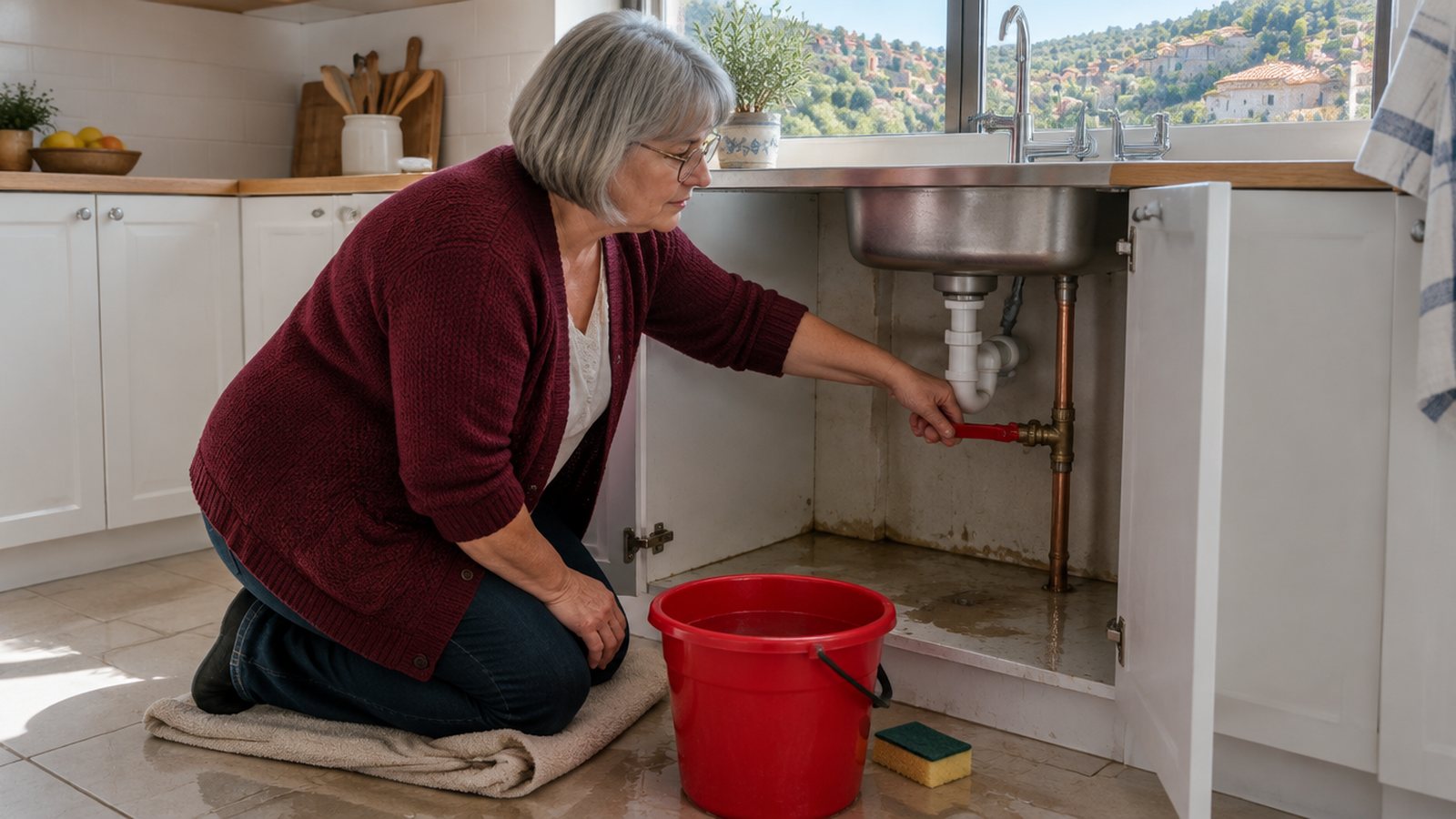
- Close the valve. First the one for the room where it leaks; if you do not know which one that is, the main valve after the water meter. Close it without force, until you feel resistance. Old valves are brittle.
- Switch off the water heater if it is connected to the valve you closed.
- Mind the electricity. If water is leaking near sockets, switches or appliances, switch off the circuit breaker for that part of the home, but only if you are standing somewhere dry. If the fuse box itself is wet, do not touch it and call an electrician.
- Open a tap to release the water and pressure left in the pipes.
- Mop up the water with towels and a bucket.
- Take photos before you clean up: the stain, the floor, the ceiling, damaged items and the water meter. Keep the broken piece of pipe when the plumber removes it. You will need all this for the water utility, your insurer or your neighbour.
- Tell the neighbour below if the water may have gone through the ceiling.
- Call a plumber. Tape or a cloth around the pipe only helps until the plumber arrives.
Do not drill into the wall blindly and do not paint over a wet stain. Paint will not stop the water; it only hides the trace the plumber needs.
Signs of a leaking pipe in the wall
A small crack or a joint that weeps can drip for weeks. Watch for:
- a wet or dark stain that keeps growing, even when it is not raining,
- paint that peels or blisters, plaster that crumbles,
- a damp smell and mould next to the bathroom or kitchen,
- the sound of running water when nobody is using any,
- the water meter turning even though every tap is closed,
- a water bill that suddenly jumps while your usage is the same.
A stain does not always mean a leaking pipe. If it gets worse after rain, water is probably getting in from outside, and stains in cold corners in winter are often condensation. We explain the difference in our guide to damp and mould on walls.
How to find a hidden water leak in a wall: the water meter test
The water meter is the simplest leak detector you already have. It has a small indicator, a star or a little wheel, that turns even at a very low flow.
- Close every tap. Make sure the washing machine and dishwasher are not running and the toilet cistern is full.
- Tell everyone at home not to use water for the next half hour.
- Photograph the meter so that all digits, black and red, are visible.
- Wait 15 to 30 minutes.
- Photograph it again from the same spot.
- Compare the photos. If the red digits have moved or the indicator is turning, water is going somewhere.
A slow leak does not always show within half an hour. Then photograph the meter in the evening and again in the morning before anyone uses water. If the numbers change overnight, you have a leak.
If the building has only one shared water meter, the test only makes sense if all residents stop using water at the same time.
Closing one branch at a time
Once you know water is flowing, narrow it down. Close the valves in your home one at a time and wait about ten minutes after each one.
| What you close | If the meter stops | Next step |
|---|---|---|
| Angle valve under the toilet cistern | The cistern is leaking | Replace the cistern mechanism |
| Bathroom valve | The fault is in the bathroom | Check the joints, the shower and the pipe behind the wall |
| Kitchen valve | The fault is in the kitchen | Check the tap, angle valves and the dishwasher |
| Valve before the water heater | The loss is at the heater or its safety valve | Call a service technician, do not close the safety valve |
| No valve stops the meter | The fault is on a section you cannot isolate | Call a plumber |
Only touch the valves after the water meter. The valve before the meter and the seal on it are not yours.
Supply pipe or drain?
The supply pipe is always under pressure, so it leaks even when nobody uses water. Then the meter turns too. A drain only leaks when you use the basin, shower, bath or toilet.
A simple trick: trace the edge of the stain with a pencil and keep an eye on it. If the stain spreads although nobody used the drains, the supply pipe is the likely cause. If it only grows after a shower or washing up, suspect the drain, the trap or the silicone around the bath and shower.
If the stain is on a wall you share with a neighbour, check their side too.
How a plumber finds a burst pipe in the wall
If you are wondering how to find a burst pipe in a wall without demolition, the answer is water leak detection. The plumber first narrows down the spot and only then opens the wall. The darkest part of the stain is not always where the crack is. Water runs along the pipe, through cavities and along the ceiling slab until it finds a way out.
The most common methods:
- moisture meter: shows where the wall is wettest and how the damp spreads,
- thermal imaging camera: shows temperature differences, works best on hot water pipes and underfloor heating,
- acoustic device: picks up the sound of water escaping from a pressurised pipe,
- tracer gas: a special gas mixture is let into the empty pipe and a detector finds it where it escapes,
- pressure test: checks whether the system holds pressure, section by section.
No method is perfect on its own. A good plumber combines the measurements and only then opens a small part of the wall. Ask in advance which method they use, how much of the wall they plan to open and who does the plaster, paint or tiles afterwards.
Who pays: your pipes, the building or the neighbour
The water utility maintains the public network and the connection up to the water meter. Everything after the meter is the internal plumbing, and the user, that is the owner, maintains it at their own cost. Zagreb's water utility ViO says exactly that.
| Where the fault is | Usually responsible | Who to call |
|---|---|---|
| A pipe in your flat, after your valve | You as the owner | A plumber |
| Shared riser, supply or drain | The building's co-owners, from the reserve fund | The co-owners' representative or the building manager |
| A pipe in the flat above you | The owner of that flat | The neighbour, then their insurer |
| Public network or connection up to the meter | The water utility | The utility's emergency service |
Under the Croatian Building Management and Maintenance Act, the shared parts of a building must be insured, including against water escaping from water and sewage pipes. So if the fault is on a riser, tell the co-owners' representative straight away.
If water is coming through your ceiling, first ring the neighbour above. In Zagreb, faults on the public network and the house connection are reported to ViO on the emergency number 01 6163 999.
A burst pipe and the water bill
When a burst water pipe pushes up your bill, the bad news is this: the utility charges for everything that went through the meter. ViO states on its website that it is not obliged to write off debt caused by a fault in the internal plumbing.
Still, it is worth trying. ViO has a form for a request to its Commission for writing off water services, and with it you attach:
- the invoice from the licensed plumber who fixed the fault, or the receipt for the materials you bought,
- the meter reading when the fault was fixed,
- the meter reading on the day you submit the request.
Other water utilities have their own rules, so check with yours. With ViO you can dispute a bill within 15 days of receiving it.
Check your home insurance policy as well. Some policies offer extra cover for water escaping from pipes. With one insurer, that cover also includes the cost of finding the fault and the bill for the extra water used. Terms differ, so read your own policy. Report the damage as soon as you can; many insurers ask for it within three days.
After the repair: dry the wall before painting
Once the pipe is fixed, do not close up or paint the wall right away. Wet plaster needs time to dry, otherwise stains and mould come back. Air the room and heat it evenly. If bathroom tiles had to be broken, you can find approximate prices for new ones in our guide to tiling cost per m².
The night after the repair, repeat the water meter test. If the numbers do not move, the fault really is fixed.
Frozen water is one of the common reasons pipes burst, so protect pipes in unheated spaces before winter. The steps are in our guide on how to stop water pipes freezing.
How to write a request on Gigron
The clearer your request, the faster you get a reply. Include:
- where it leaks: wall, floor or ceiling, and in which room,
- since when you have noticed the stain and whether it is growing,
- whether the meter turns when all taps are closed,
- whether it leaks all the time or only when you use the shower or basin,
- whether you closed the valve and whether you have water now,
- flat or house, the floor and the year it was built if you know it,
- city, neighbourhood and a time that suits you.
Add photos of the stain and the water meter.
Example: "I have a wet stain on the wall between the bathroom and the hallway in Rijeka (Krimeja), a flat on the 2nd floor, building from the 1970s. The stain has been growing for three days, even when nobody uses the bathroom. The flat's water meter turns when all taps are closed. I closed the bathroom valve and the leak stopped. I need leak detection and a pipe repair, with as little breaking as possible. Can someone come this week?"
On Gigron, browse the categories plumbing, leak repair and pipe repair. You can find plumbers in Zagreb, Rijeka, Pula and Šibenik, plus leak repair in Zagreb and leak repair in Rijeka. For the wall after the repair, see masonry work and painting and decorating.
There are more tips in our guide on how to write a request to a tradesperson.
Find a plumber on Gigron
On Gigron you post a request and local tradespeople reply with offers. It is free, and you do not have to ring ten numbers.
Download the app:
Frequently asked questions
Can I open the wall and find the pipe myself?
You can, but it rarely pays off. Water often comes out far from the crack, so it is easy to break the wrong part of the wall or damage a cable you cannot see. It is better to let a plumber measure and mark the spot first.
What if I cannot close the valve?
Close the main valve after the water meter. If that does not work either and the water is pouring out, in a building tell the co-owners' representative or the building manager straight away. Check where your valves are in advance, while everything is fine.
Does insurance pay for a burst pipe in the wall?
It depends on the policy. Building insurance usually covers the shared parts, while your flat needs its own policy with cover for escaping water. Some policies also pay for finding the fault and the higher water bill, others do not. Read the terms and report the damage as soon as you can, with photos and receipts.
In short: with a burst pipe in the wall, first close the valve, mind the electricity and photograph the damage. Use the water meter test to check whether there really is a leak and narrow it down by closing valves one at a time. Let a plumber find the fault by measuring, not by breaking the wall blindly. Keep the receipts and meter readings; you will need them to ask for a bill write-off or an insurance payout.