Salt efflorescence on walls: causes and how to stop it coming back
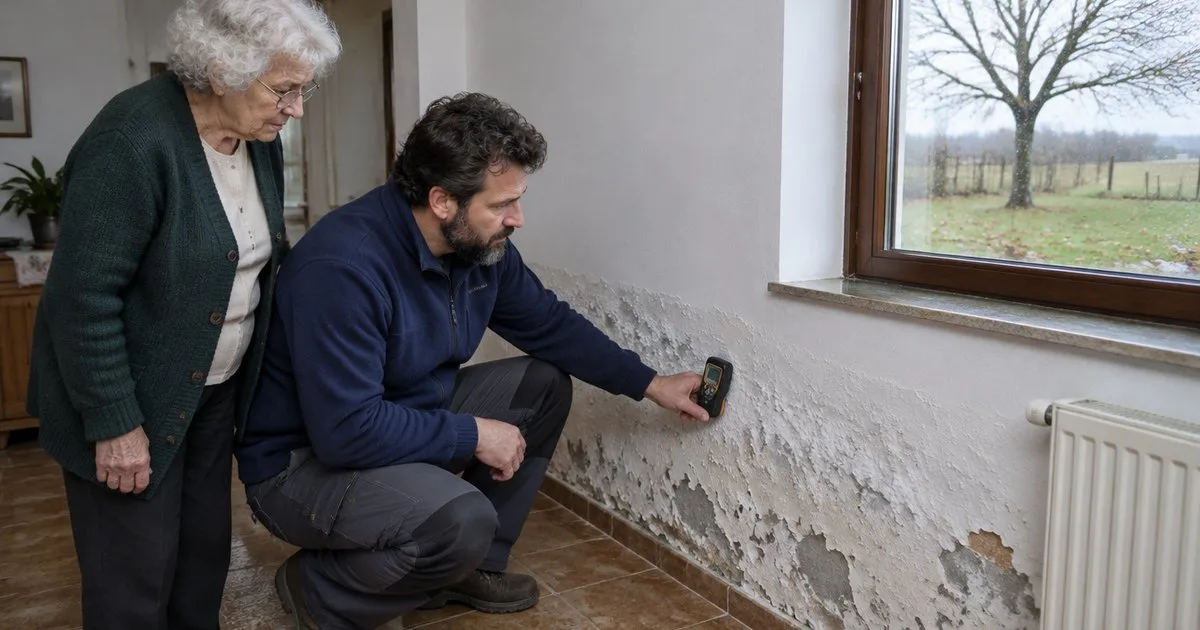
White powder appears at the bottom of a wall. You wipe it off, and a few weeks later it's back. The paint bubbles and the plaster crumbles. Most often this is salt efflorescence on walls (in Croatian „salitra”): salts that moisture carries out of the wall to the surface. The deposit itself is mostly a cosmetic problem. But it tells you there is moisture in the wall, and over time that moisture destroys plaster and paint.
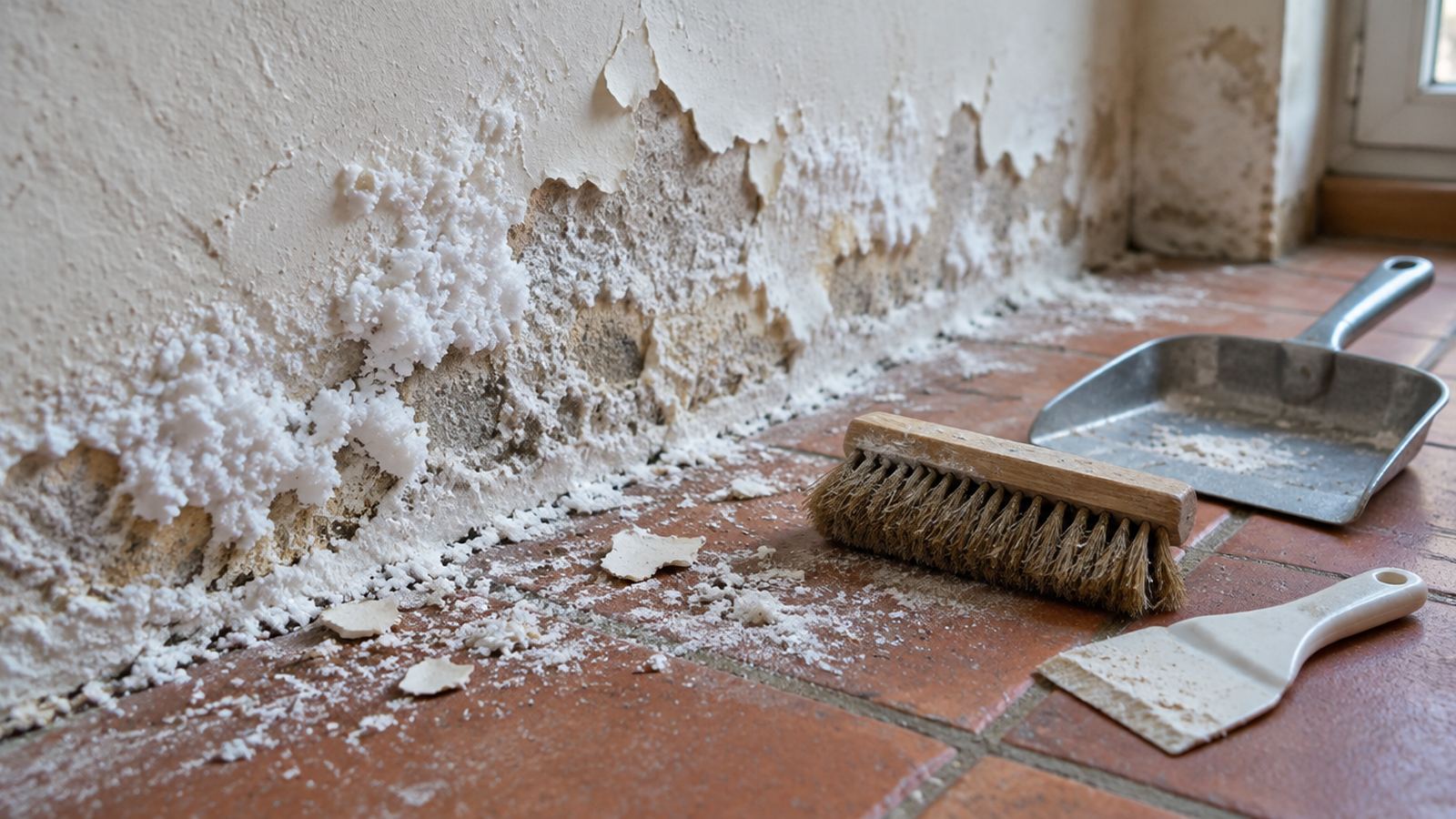
In this guide you'll find how to tell efflorescence from mould, where it comes from, how to clean it without damage and what to do so it doesn't come back. The advice is based on technical guidance from manufacturers of renovation plasters and bricks and on the experience of Croatian damp-repair and facade-cleaning companies.
Salt efflorescence on walls: the short answer
- White, dry powder or crystals near the floor or the ground are most often efflorescence.
- When the wall is dry, remove it with a dry, stiff brush.
- Wipe off what's left with a damp cloth and rinse the cloth often in clean water.
- Sweep up and collect the powder from the floor along the wall.
- Find out where the moisture comes from. Without that, the efflorescence will come back.
- If it keeps coming back and the plaster is falling off, call a waterproofing specialist.
Need someone for this job? Describe it and get quotes →
What efflorescence is and why it keeps coming back
The technical term is efflorescence. Water gets into the wall and carries dissolved salts. When it evaporates at the surface, the salts stay behind as white powder or crystals.
Three things are needed: a source of salt in the wall, enough moisture to dissolve it and a path to the surface. If you remove at least one, there is no efflorescence. With efflorescence inside a home, you therefore start with the moisture.
That's why cleaning only restores the look. As long as moisture keeps getting into the wall, new salts reach the surface. The worst damage happens where crystallisation is strongest. Crystals grow in the pores and push paint and plaster outwards.
Efflorescence or mould: how to tell them apart
| Efflorescence | Mould | |
|---|---|---|
| Colour | white, sometimes yellowish | black, green or grey |
| Appearance | dry powder or crystals | stains and dots |
| Where it usually is | bottom of the wall, plinth, near the ground | corners, behind wardrobes, around windows |
| Where it comes from | moisture and salts from the wall | a damp surface, often condensation |
| First step | find the source of moisture in the wall | ventilate and remove the mould |
Sometimes both are on the same wall. With rising damp the wall is damp and cold, so mould can also appear on the inside. How to deal with mould is in the guide damp and mould on walls.
Why efflorescence forms on walls
Rising damp from the ground
This is the most common cause in older houses. A porous wall soaks up water from the ground like a sponge. The water carries salts and leaves them in the wall when it evaporates. The cause is usually that the wall has no horizontal damp-proof course, or that it is damaged. The efflorescence then shows at the bottom of the wall, inside and outside, often with peeling paint and falling plaster.
How rising damp is stopped and what it costs is in the guide rising damp injection cost.
Water from outside: rain, gutter, terrace, pipe
Moisture doesn't always come from the ground. Efflorescence can be caused by rainwater running down the wall, an overflowing gutter, a plinth that soaks up water or a badly finished terrace edge next to the house. Inside the wall, a leaking pipe can cause it too. Expert guides for old buildings therefore first advise leading rainwater away from the wall and fixing leaks.
If the gutters overflow, see the guide how to clean gutters. If you suspect a pipe in the wall, there's the guide burst pipe in the wall.
New buildings, brick and concrete
Efflorescence also appears on new walls. Salts can be in the sand, cement, lime or the water used for mortar. On the coast, wind or rain can bring them too. If an unfinished wall was left in the rain, efflorescence is more common. That's why a brick manufacturer advises covering unfinished masonry with plastic sheeting.
On concrete, white powder often appears in the first months after pouring. Most often this is lime from the cement, which turns into calcium carbonate in contact with air. Such deposits are often hard and more difficult to remove.
How to remove efflorescence from a wall: step by step
- Wait until the wall is dry. Salts are easier to brush off a dry wall.
- Brush dry. Take a stiff brush and remove as much salt as you can, without extra water.
- Wipe off the rest. Use a damp cloth and rinse it often in clean water. Change the water, because salts collect in it.
- Sweep the floor along the wall. Crystals that fall off must not stay next to the wall. Otherwise they can dissolve and get back into the wall.
- Remove whatever is coming off. Don't paint over bubbled paint and crumbling plaster. Those parts need to be removed and repaired later.
- Watch the wall for a few weeks. If the efflorescence comes back, moisture is still getting into the wall.
For new walls, a brick manufacturer says efflorescence is removed with a brush and a damp cloth, after which the wall can be coated with an anti-efflorescence product. If there is a lot of salt in the wall, the process needs to be repeated.
Efflorescence on a facade
On a facade, efflorescence is usually seen on the plinth and along the bottom edge of the wall. It's easy to mistake for algae or mould. Algae and fungi are green or black and live on the surface. Efflorescence is white, dry and comes from inside.
A Zagreb facade-cleaning company removes the deposit mechanically and with a suitable product, without high pressure. High pressure on damp render does more harm than good. They stress the same thing: if the source of moisture isn't dealt with, the efflorescence comes back. If the facade needs washing, prices are in the guide facade washing cost per m².
Efflorescence on concrete and tiles
On concrete, the first step is also dry brushing with a stiff brush. A Croatian manufacturer of concrete products writes that this is often enough, while many people go straight for acid.
If brushing doesn't help, the same manufacturer mentions diluted hydrochloric acid, 1:10 to 1:20 with water. You first wet the surface with clean water. The acid works briefly, usually a minute or two, and then everything is rinsed thoroughly. Acid that stays behind eats into the concrete. For tiles there are acidic cleaners that also remove efflorescence, but only on acid-resistant materials. Follow the instructions on the packaging.
Don't use acid on brick, plaster or paint. A German brick manufacturer warns that hydrochloric acid can itself cause new efflorescence and permanently discolour the brick.
What not to do
- Don't paint over efflorescence. The paint bubbles and falls off, and the salt stays.
- Don't put acrylic paint on a damp wall. Acrylic paint seals the surface and the wall can't dry.
- Don't fix polystyrene insulation to a damp wall from outside. The moisture then stays in the wall and does even more damage inside.
- Don't cover a damp wall with plasterboard. Mould easily grows between the board and the damp wall.
- Don't wash efflorescence off with a strong jet of water. Water dissolves the salts and returns them to the wall, and high pressure damages damp plaster.
- Don't use acid on brick and plaster.
How to stop efflorescence coming back
Manufacturers of renovation plasters split the repair into two steps.
First the cause. The moisture has to be stopped or reduced. For rising damp, that means a horizontal damp-proof course: injection, cutting the wall or inserting sheets. In basements, vertical waterproofing can be done. If water from outside is to blame, the solution is gutters, drainage and fixing leaks. For basements, see also the guide damp basement.
Then the wall. Damaged plaster is removed and the wall is plastered with a renovation (desalination) plaster. This kind of plaster is very porous and lets vapour through. Salts stay in its pores, while the surface stays dry and free of deposits. A Croatian damp-repair company says such plaster lasts 15–30 years, depending on the moisture in the wall and the amount of salt.
Vapour-permeable paint goes on last. One manufacturer of renovation plasters recommends a vapour-permeable mineral paint with them. If you paint the wall after the repair, see also the guide wall painting and skim coating cost per m².
For old stone or brick houses built without cement, it also matters that the materials are cement-free. For such walls, manufacturers offer lime-based renovation plasters without cement.
Example: efflorescence on the ground floor of an older house
This is a made-up example. Ana has a house from the 1960s near Đakovo. After a rainy autumn, white powder appears near the floor on the living-room wall, and the paint starts peeling. Ana brushes the wall dry and collects the powder from the floor. A month later the powder is back in the same spot.
Outside she sees that the gutter on that corner overflows and the water falls straight down next to the wall. A waterproofing specialist measures the moisture and says the wall is also drawing water from the ground. They agree on fixing the gutter, injecting the wall and renovation plaster up to the height of the damage. They choose vapour-permeable paint.
Your situation may be different. The cause is determined by a tradesperson on site.
When to call a tradesperson, and which one
Call a tradesperson if:
- the efflorescence comes back even after cleaning,
- the plaster is falling off or crumbling,
- the efflorescence is at the bottom of the wall both inside and outside,
- the walls feel damp and cold to the touch,
- mould appears alongside the efflorescence,
- you don't know where the water is coming from.
For rising damp and basements you call a waterproofing specialist. For removing and replacing plaster you call a mason. If a pipe is to blame, you need a plumber. For painting after the repair you call a painter.
Find a tradesperson for efflorescence and damp
You'll find tradespeople in the category waterproofing, e.g. in Zagreb, Split, Rijeka or Osijek. For basements and foundations there's foundation and basement waterproofing. For plaster see masonry work, for the facade facades and facade washing, and for leaking pipes leak repair. For painting there's painting and decorating. Category pages are in Croatian.
This is a made-up example of a request you could send:
"On the living-room wall on the ground floor of a house from the 1960s, up to about 50 cm, white powder keeps appearing and the paint is peeling. The house is near Đakovo and the wall is brick. Outside, the gutter on that corner overflows. I need an assessment of the cause of the damp and a quote for the repair. Please state what's included in the price and whether VAT is included. I can send photos."
How to write a good request is in the guide how to write a request to a tradesperson. What to ask for on the invoice and how the warranty works is in the guide warranty on building work.
Find a tradesperson through Gigron
On Gigron you post a job for free, and tradespeople near you get back to you with quotes. Send photos of the wall and say where the efflorescence appears. Compare the quotes and ask what's included in the price. Download the app:
Frequently asked questions
How do I remove efflorescence from a wall?
When the wall is dry, brush it off dry with a stiff brush. Wipe off the rest with a damp cloth that you rinse often, and collect the powder from the floor. If it comes back, the moisture in the wall needs to be dealt with.
Is efflorescence dangerous?
The deposit itself is mostly a cosmetic problem. But it's a sign of moisture in the wall, and over time that moisture destroys plaster and paint. Mould can also appear on damp walls.
Can I just paint over efflorescence?
No. Paint over efflorescence bubbles and falls off. First the moisture has to be dealt with and the damaged plaster removed, and only then do you paint with vapour-permeable paint.
Why does efflorescence come back after cleaning?
Because moisture keeps getting into the wall and brings new salts. Cleaning only restores the look. If there is a lot of salt in the wall, efflorescence can come back on new walls too.
Can I remove efflorescence with acid?
Don't use acid on brick, plaster or paint. It can cause new efflorescence and permanently discolour the brick. On concrete and acid-resistant tiles, diluted acidic products are used, strictly according to the instructions.
Summary
Salt efflorescence on walls is salt that moisture carries to the surface. Remove it dry with a brush and collect the powder from the floor. Don't paint over it and don't wash it with a strong jet. To stop it coming back, the moisture has to be stopped and the wall repaired with a vapour-permeable renovation plaster. If you don't know where the water comes from, post a job on Gigron and compare quotes from tradespeople near you.
Need someone for a job?
Describe what you need, where and by when.
The AI assistant writes the post; you post it in the Gigron app.