Underfloor heating cost per m² in Croatia: water vs electric
Thinking about underfloor heating in a house, a flat or just the bathroom? The first question is always the same: how much does it cost per square metre. When you search for underfloor heating cost per m² in Croatia, you get figures from about thirty to a couple of hundred euros. The gap is big because a water (hydronic) system and an electric system are not the same job. It also matters what the quote includes: only the pipes, or the manifold, screed and controls too.
This guide gives you rough 2026 prices per m² for water and electric underfloor heating, equipment prices from Croatian web shops, real requests from Croatian tradesperson portals and two worked examples.
Underfloor heating cost per m² in Croatia in 2026
The figures below are rough ranges from the public price lists of two Croatian tradesperson portals and one heating equipment web shop (checked on 4 November 2026). They are not a Gigron offer or a fixed price. They depend on the floor area, number of rooms, insulation, floor finish and what the quote includes.
| What you pay for | Roughly (€ per m²) |
|---|---|
| Water: supply and laying of panels and pipes, ready for screed (no manifold) | ~39 |
| Water: installation only, manifold connection and pressure test (you supply materials) | ~20–25 |
| Water: system with panels, manifold and pressure test | ~60–180 |
| Water: range given by a second tradesperson portal | ~75–230 |
| Electric: heating mat with installation | ~50–120 |
| Electric heating mat, material only | ~40–80 |
| Infrared heating film, material only | ~12–14 |
| Screed over the pipes (cement or anhydrite) | ~9–16 |
The price of a water system never includes the heat source. That is a gas condensing boiler, a heat pump or another boiler. The floor finish and removing the old floor are also paid separately. For screed prices see the guide floor screed cost per m².
Need someone for this job? Describe it and get quotes →
Water or electric underfloor heating
In short: water heating is for a whole house or flat, electric is usually for a bathroom or a single room.
| Water | Electric | |
|---|---|---|
| How it works | warm water flows through pipes in the screed | heating cable on a mesh under the tiles |
| Needs a heat source | yes, a boiler or heat pump | no, it runs on electricity |
| Needs a manifold | yes, usually one per floor | no, just a thermostat |
| Floor height | insulation, pipes and screed, several centimetres | a few millimetres in the tile adhesive |
| Heat-up | slower, the screed stores heat | faster |
| Retrofitting | usually means breaking up the old floor | possible even over old tiles |
| Running cost | depends on the heat source | uses electricity directly |
Water heating makes sense when you are laying new floors across the whole house or flat anyway. One Croatian tradesperson portal says electricity is the most expensive energy source. So for a whole flat, look at the running cost, not just the installation price.
Electric heating is simpler for one room. The mat goes into the tile adhesive, so the floor rises only a few millimetres. That way a bathroom can be heated without new pipes and without breaking the screed.
How much does water underfloor heating cost per m²
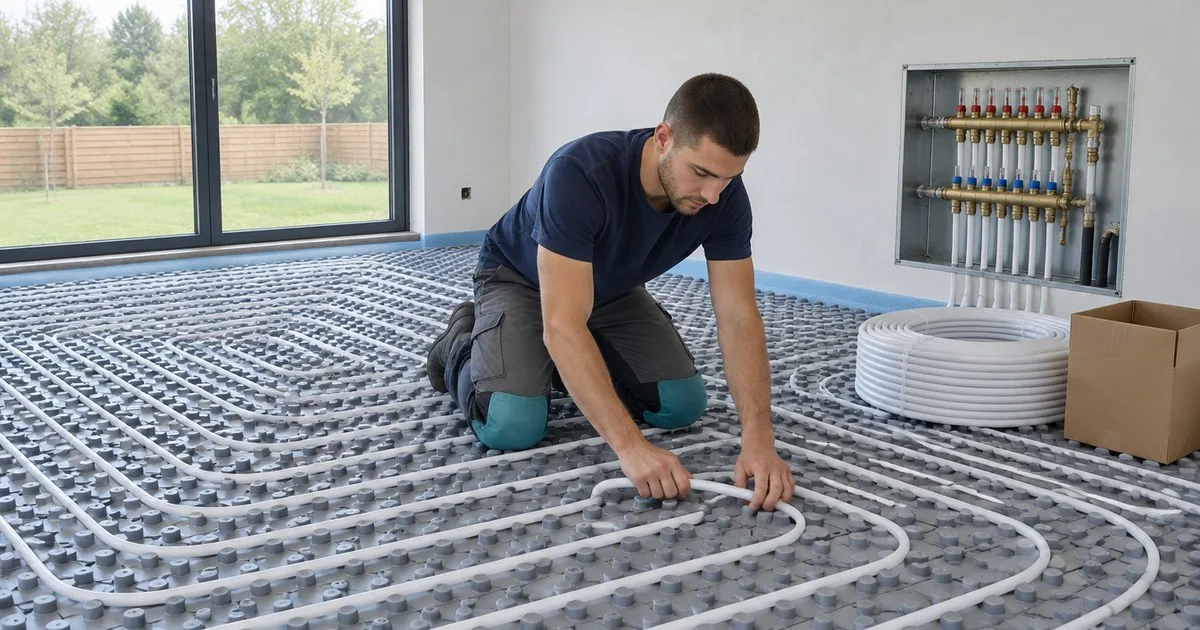
A water system has several layers: an insulation or system panel, pipes, edge strip, a manifold with a cabinet and controls. Screed goes on top, and only then tiles, laminate or parquet.
Equipment prices from Croatian web shops (4 November 2026, incl. VAT, no labour):
| Equipment | Price |
|---|---|
| Tacker panel 3 cm with aluminium foil | €5.00 per m² |
| Nubbed system panel (polystyrene 3–5.5 cm) | ~€9.50–15.50 per m² |
| PE-RT pipe 16 × 2 mm | ~€0.73–0.92 per metre |
| Pipe per m² of floor (5–7 m of pipe) | ~€4–12 per m² |
| Edge strip | €0.77 per metre |
| Manifold, 2–10 circuits | ~€67–221 |
| Manifold cabinet | ~€77–139 |
| Thermoelectric actuator, per circuit | ~€12–14 |
| Room thermostat | ~€37–69 |
A web shop from Rijeka added up the equipment for a 100 m² house. The budget option comes to about €20 per m², and a pricier one with better-known brands about €31 per m². That is equipment only, without screed, labour or heat source.
The same shop offers supply and installation for €39.01 per m², ready for screed. A manifold station in a cabinet with installation costs from €328.88 for 3 circuits to €537.65 for 12 circuits. One tradesperson portal says installation, connection and the pressure test alone cost €20–25 per m² if you supply the materials.
What a water underfloor heating quote should include
When comparing quotes, check that each one covers:
- insulation or system panel and its thickness,
- pipes and pipe spacing, because tighter spacing means more metres of pipe,
- manifold, cabinet and number of circuits, usually one circuit per room,
- controls: thermostats and actuators per room,
- pressure test before the screed,
- screed and who lays it,
- connection to the boiler or heat pump.
A quote of €39 per m² and one of €90 per m² often do not describe the same job. The first may be just pipe on panels. The second may include screed, manifold and controls.
Real requests from tradesperson portals
These are the portals' estimates for published requests, not final prices. We worked out the per-m² figures.
| Request | Estimate | Per m² |
|---|---|---|
| Water, ground floor 50 m², basement below | €4,500 | ~€90 |
| Water, renovation 44 m², existing condensing boiler, 30 mm panels, vinyl on top | €3,069–5,115 | ~€70–116 |
| Water, house 80 m², owner removes the old floor | €3,465–5,775 | ~€43–72 |
| Water, flat 120 m² with materials, existing condensing boiler | €10,800–18,000 | ~€90–150 |
| New build 140 m² on two floors | €11,200 | ~€80 |
How much does electric underfloor heating cost per m²
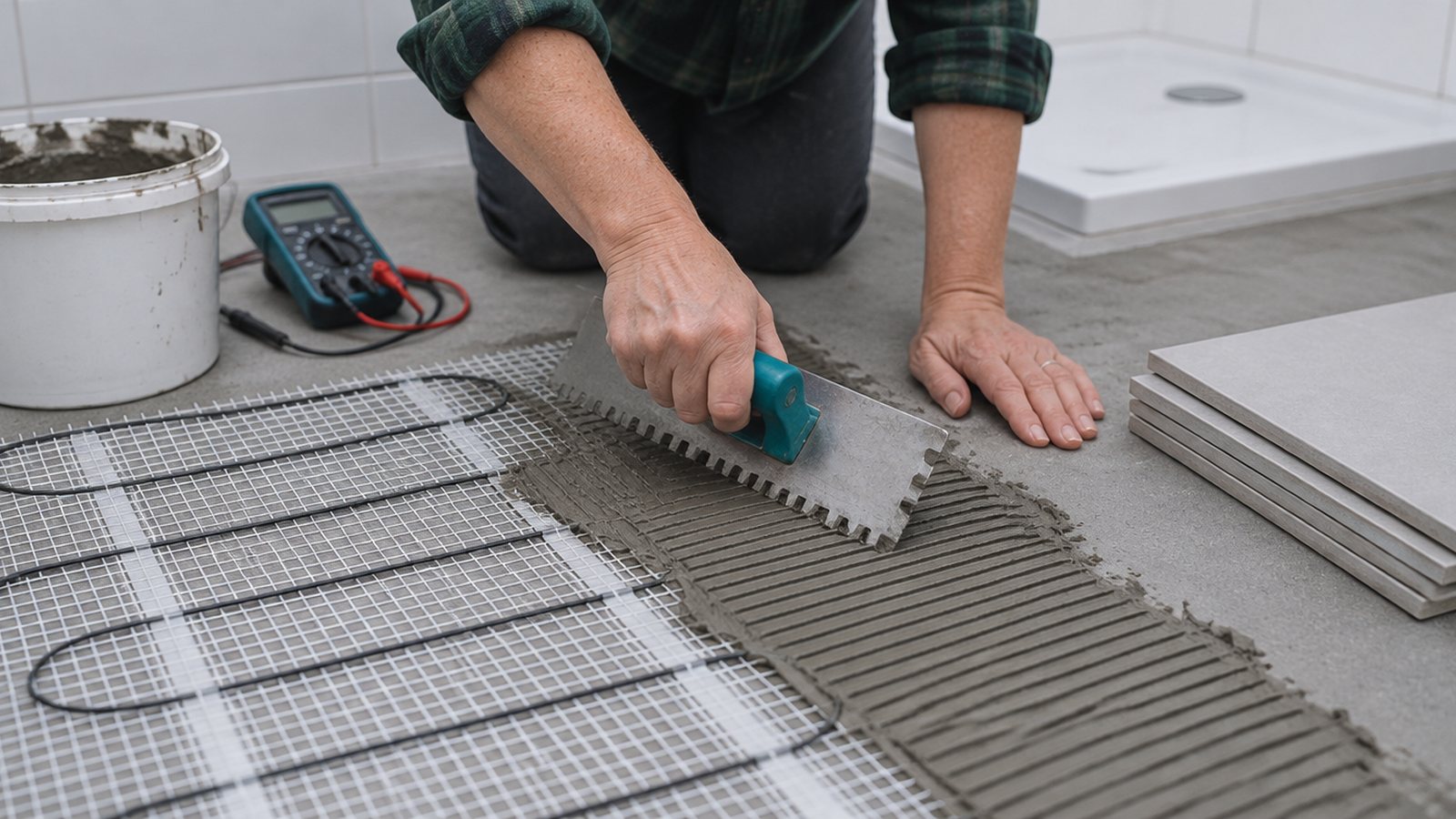
An electric system is a heating mat and a thermostat with a floor sensor. No pipes, no manifold, no boiler. The mat is stuck to the subfloor and covered with tile adhesive.
Prices of 150 W per m² heating mats in Croatian web shops (4 November 2026, incl. VAT, no labour):
| Mat | Price | Per m² |
|---|---|---|
| Budget brand, 2 m² | €57.50 | ~€29 |
| Another brand, 1 m² / 2 m² / 4 m² | €55.80 / 80.10 / 135.90 | ~€56 / 40 / 34 |
| Danfoss ECmat, 1 m² / 2 m² / 4 m² | €115 / 168 / 283 | ~€115 / 84 / 71 |
| Danfoss kit with thermostat, 1 m² / 2 m² / 3 m² | €245 / 298 / 359 | incl. thermostat |
As you can see, a small mat costs more per m². The thermostat is the same for 2 m² and for 10 m², so in a small bathroom the price per m² climbs quickly.
Real requests from tradesperson portals for electric heating:
| Request | Estimate |
|---|---|
| Bathroom, about 4.5 m² heated area, Wi-Fi thermostat | €630–1,050 |
| 5 m² of electric heating | €450–750 |
| 15 m², living room, house renovation | €1,800 |
| Renovation, 23 m² | €2,070–3,450 |
| 59 m², five rooms, no existing floor | €4,720 |
Rules for electric heating mats
Danfoss lists several rules in the instructions for its mats. Other manufacturers have similar ones:
- the mat is connected by a qualified electrician, through an RCD of no more than 30 mA,
- the heating cable must not be cut and must not cross itself,
- the mat must be fully embedded in adhesive, screed or concrete, at least 5 mm including the tiles,
- a floor sensor is mandatory, and the thermostat limits the floor temperature to 35 °C,
- the mat does not go under walls, a bath, shower tray or built-in cabinets.
So before laying it, measure where furniture and sanitary ware will stand. The heated area is usually smaller than the whole room.
Example 1: bathroom with electric heating
This is a made-up example, for orientation only. The bathroom is 5 m², and the mat covers about 3 m² of free floor, not under the shower tray or vanity. The old tiles are coming off anyway.
- Danfoss 3 m² kit with thermostat: €359
- Budget 3 m² mat: about €100, plus a thermostat bought separately
- Labour and connection: one request for a 4.5 m² bathroom was estimated by a portal at €630–1,050 in total
Tiles, adhesive and the tiler's labour are extra. For those costs see the guide tiling cost per m².
How much electricity does it use? A 3 m² mat at 150 W per m² is 450 W. If it ran at full power for 2 hours a day, it would use 0.9 kWh. The thermostat switches it off when the floor reaches the set temperature, so real use is lower. The calculation is ours.
Example 2: 80 m² ground floor with water heating
This is a made-up example, for orientation only. New floors on an 80 m² ground floor, and a boiler or heat pump is already in place.
| Item | Calculation | Roughly |
|---|---|---|
| Equipment (panels, pipes, strip, manifold, controls) | 80 × €20–31 | €1,600–2,480 |
| Installation and pressure test | 80 × €20–25 | €1,600–2,000 |
| Cement screed over the pipes | 80 × €9–16 | €720–1,280 |
| Total | €3,920–5,760 |
That is about €49–72 per m², without removing the old floor, the floor finish or the heat source. A portal request for an 80 m² house in the table above was estimated at €3,465–5,775, so the order of magnitude is similar. The calculation is ours.
What pushes the price of underfloor heating up
- Removing the old floor. In a renovation, the tiles or parquet and the old screed come out first.
- Floor height. If there is no room for insulation and screed, you need low-profile systems, which cost more.
- Insulation. On the ground floor and above a basement, thicker insulation costs more, but less heat escapes into the ground.
- Number of rooms. More circuits mean a bigger manifold and more thermostats.
- Heat source. Underfloor heating runs on lower water temperatures. A boiler that heats hotter water often also needs a mixing module.
- Small area. With electric heating, the thermostat and the call-out are the same for 3 m² and 15 m².
Which floors work with underfloor heating
Tiles are the best choice because they conduct heat well. For bathroom tiles Danfoss allows mats of 100 to 200 W per m².
Laminate is usually approved by manufacturers only for water underfloor heating in screed, with a surface temperature of no more than 28 °C. Laminate usually does not go on heating film. More in the guide laminate flooring installation cost.
Parquet should also be checked in the manufacturer's instructions. For wood, parquet and laminate over thin build-ups Danfoss allows no more than 100 W per m². Thick rugs and furniture without legs trap heat, so keep them off the heated area.
Screed, first heating and moisture
After a water system comes the screed. For cement screed, about 4.5 cm over the pipes is often quoted, but the designer or heating installer sets the exact thickness.
Then comes functional heating according to EN 1264-4. For cement screed it starts no earlier than 21 days after pouring, for anhydrite after 7 days. For the first 3 days the water is around 25 °C, then at least 4 days at the maximum design temperature. The screed manufacturer may have different rules.
Functional heating does not mean the screed is dry enough for flooring. Before laminate or parquet, moisture should be measured with the CM method. For cement screed with underfloor heating, laminate instructions ask for no more than 1.8 %. Drying times and the heating protocol step by step are in the guide screed drying time.
Questions worth asking before you get a quote
- Is the price per m² with materials or labour only?
- What insulation goes under the pipes and how thick is it?
- What is the pipe spacing and how many circuits are there?
- Are the manifold, cabinet and thermostats included?
- Who lays the screed and who runs the functional heating?
- Is the pressure test included and do you get a written record?
- For electric: who buys the mat and thermostat, and who connects them?
- Is VAT included?
When to find a tradesperson through Gigron
Underfloor heating is not something to improvise. A water system needs a calculation of heat losses, pipe spacing and circuit lengths. An electric one must be connected by an electrician. If you are renovating, line up the heating installer, electrician, screed layer and tiler before anyone starts demolishing.
How to write a good request on Gigron
Include:
- water or electric heating, if you know,
- floor area and number of rooms,
- whether it is a new build or renovation and what is on the floor now,
- the heat source you have or plan,
- the floor finish: tiles, laminate or parquet,
- location and rough timing.
More tips in the guide how to write a request to a tradesperson. For how warranties on finished work apply, see warranty on building work.
Example request (made up): “I need water underfloor heating on the ground floor of a house, about 80 m², four rooms and a hallway. We will remove the old floor ourselves. We have a gas condensing boiler. Tiles and laminate go on top. Please quote per m² and in total, incl. VAT, with manifold and screed. Rijeka, work in February.”
Find an underfloor heating installer on Gigron
On Gigron you post a request and local tradespeople reply with offers. It is free and you do not have to call ten numbers. Browse tradespeople for heating, heating in Zagreb and heating in Rijeka. For electric heating you will also need electrical installations, and for the floor finish tiling or flooring.
Download the app:
Frequently asked questions
Which is cheaper, water or electric underfloor heating?
For one small room, installation is usually cheaper with electric heating, because there are no pipes, manifold or screed. For a whole flat or house, look at the running cost too. Electric heating uses electricity directly, while a water system can run on a boiler or heat pump.
Can underfloor heating go over old tiles?
Electric can. Danfoss's instructions describe laying a mat over existing tiles, with a self-levelling compound and new tiles. Water heating usually means removing the old floor, because it needs insulation and screed.
How much does underfloor heating raise the floor?
An electric mat adds only a few millimetres, in the adhesive layer. With water heating, the insulation panel, the pipe and the screed above it raise the floor. System panels in shops are 3 to 5.5 cm thick, and the screed over the pipes adds several more centimetres.
Can laminate go on underfloor heating?
Yes, if it is water underfloor heating in screed and the laminate manufacturer allows it. The floor surface temperature must not exceed 28 °C.
In short: underfloor heating cost per m² in Croatia in 2026 is roughly €40–180 for a water system, without the heat source, and €50–120 for electric with installation. Some quotes are higher. Water heating makes sense for a whole house with new floors, electric for a bathroom or a single room. Ask for a quote per m² and in total, item by item, with the manifold, screed and thermostats.
Need someone for this job?
Add the details, for example where and by when.
The AI assistant writes the post; you post it in the Gigron app.