Screed drying time: when you can lay tiles, laminate or parquet
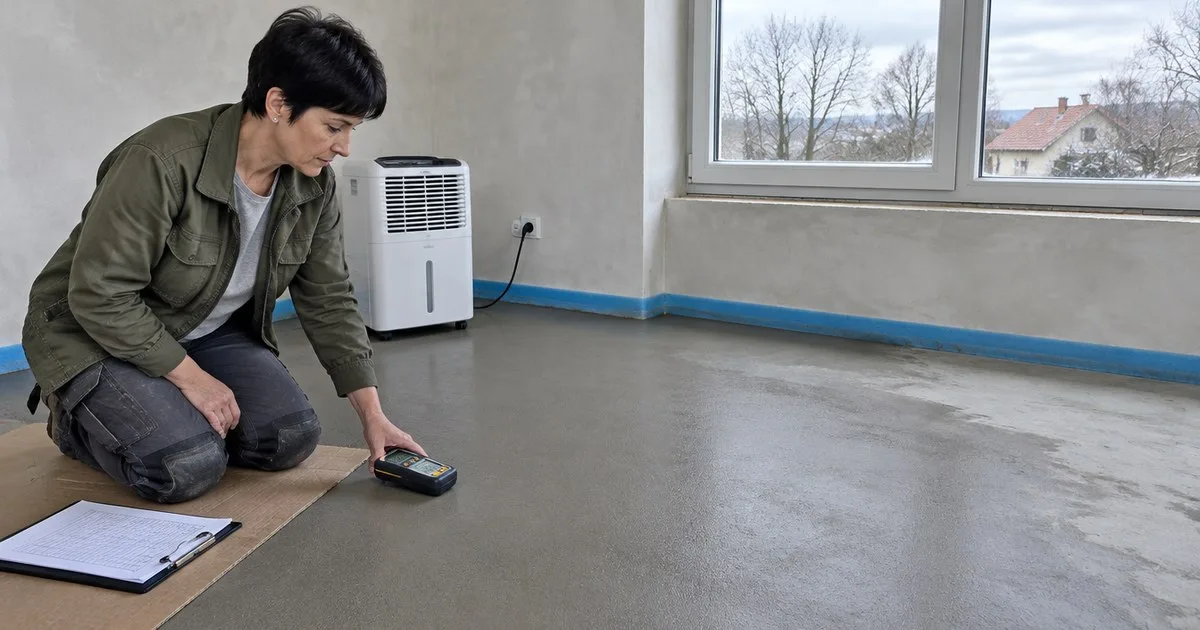
The screed is poured, you can already walk on it and it looks dry. Can you call the tiler or the laminate fitter now? Usually not yet. Screed drying time depends on the type, the thickness and the conditions in the room. A standard 5 cm cement screed in practice takes from several weeks to several months, while fast-drying screeds can be ready in a few days.
This guide covers rough drying times per screed type and floor, how moisture is measured, how drying with underfloor heating works and what to do in winter. The figures come from manufacturers' technical instructions and flooring installers' guidelines.
Screed drying time: the short answer
| Screed | Walkable | Ready for flooring | Note |
|---|---|---|---|
| Standard cement screed | after a few days | at the earliest after 28 days | the "about 1 week per cm" rule only applies to the first 4 cm |
| Cement screed, 5–6 cm | after a few days | roughly 7–9 weeks, longer in winter | using the rule of about 10 days per cm |
| Fast-setting cement screed | after 12 hours to a few days | 1 to 8 days, depending on product and floor | only under the conditions in the technical data sheet |
| Anhydrite (self-levelling) screed | per manufacturer | when the test shows very low moisture | the top layer is sanded before flooring |
| Dry screed (boards) | after installation | after installation, per instructions | no wet drying |
Whatever screed you have, the decision is made by a moisture test, not by the calendar. More on that below.
Need someone for this job? Describe it and get quotes →
Walkable, cured and dry are not the same
Three things often get mixed up:
- Walkable. You can walk on it carefully, usually after a few days. Do not put pallets of tiles or scaffolding on it yet.
- Cured. The cement has hardened enough. For standard cement screed, manufacturers state at least 28 days.
- Dry enough for flooring. Little enough moisture is left for the floor you plan. You only know this from a measurement.
The surface can look light and hard while the bottom of the layer is still wet. So do not judge it by colour or by touch.
How long cement screed takes to dry
For cement screed you often hear the rule of about one week per centimetre of thickness, but only for the first 4 cm. Every further centimetre dries more slowly, because water from the bottom has to travel through the whole layer. One adhesive manufacturer therefore works with about 10 days per centimetre.
So a 5 or 6 cm screed is not necessarily dry after five or six weeks. In a cold, damp room it can take several months.
Drying is slowed down most by:
- too much water in the mix, which makes it easier to spread, but all that water has to come out later,
- a thicker layer and thicker spots around pipes or on an uneven base,
- cold, damp air, closed windows and rainy weather,
- an open building, when the roof, windows or facade are not finished yet.
More on screed types and thickness is in the guide floor screed cost per m2.
Fast-drying and anhydrite screed
Fast-setting screeds can cut the wait to days. One manufacturer states that screed made with its binder is walkable after 12 hours, ready for tiles after 24 hours and for parquet after 4 days. That applies at +23 °C and 50 % relative humidity. On a cold site it takes longer. Another manufacturer states at least 8 days before tiling on fast-setting screed. Always check the data sheet of the exact product your tradesperson uses.
Anhydrite screed levels itself and wraps well around underfloor heating pipes. It is sensitive to long-term moisture and needs good ventilation. Before flooring, a thin hard surface layer is usually sanded off, and moisture must always be measured. The allowed moisture is much lower than for cement screed.
Screed drying for tiles, laminate and parquet
Not every floor is equally sensitive. Tiles tolerate a little more moisture than wooden floors. Laminate, parquet and vinyl need a very dry base. Otherwise they can lift, warp or come unstuck.
Flooring installers measure moisture with the CM method and give it as a percentage (CM %). These are the values most often quoted for cement screed:
| Floor | Cement, no underfloor heating | Cement, with underfloor heating |
|---|---|---|
| Laminate | up to 2.0 % | up to 1.8 % |
| Parquet | up to 1.8–2.0 % | up to 1.6–1.8 % |
| Vinyl and other resilient floors | up to 1.8–2.0 % | up to 1.8 % |
| Ceramic tiles | up to 2.0–3.0 % | per the adhesive manufacturer |
For anhydrite screed the limit is about 0.5 % without underfloor heating and 0.3 % with it.
The ranges for parquet and tiles exist because sources differ. They also depend on how the sample is taken and whether tiles are laid in a thin or thick bed of adhesive. In the end, the instructions of the floor and adhesive manufacturer apply.
- Screed drying for tiles. On cement screed, tiles go down at the earliest after 28 days, unless the screed is fast-setting. In a bathroom, waterproofing comes before tiles, see waterproofing cost per m2. Tiling prices are in tiling cost per m2.
- Screed drying for laminate. Laminate is a floating floor, but moisture from the screed still ruins it. A vapour barrier, foil or underlay with foil goes underneath, but only once the screed is dry enough. See laminate flooring installation cost.
- Screed drying for parquet. Parquet is the most sensitive, and with glued parquet you must not rush. The same goes for vinyl, see vinyl flooring cost.
How screed moisture is measured
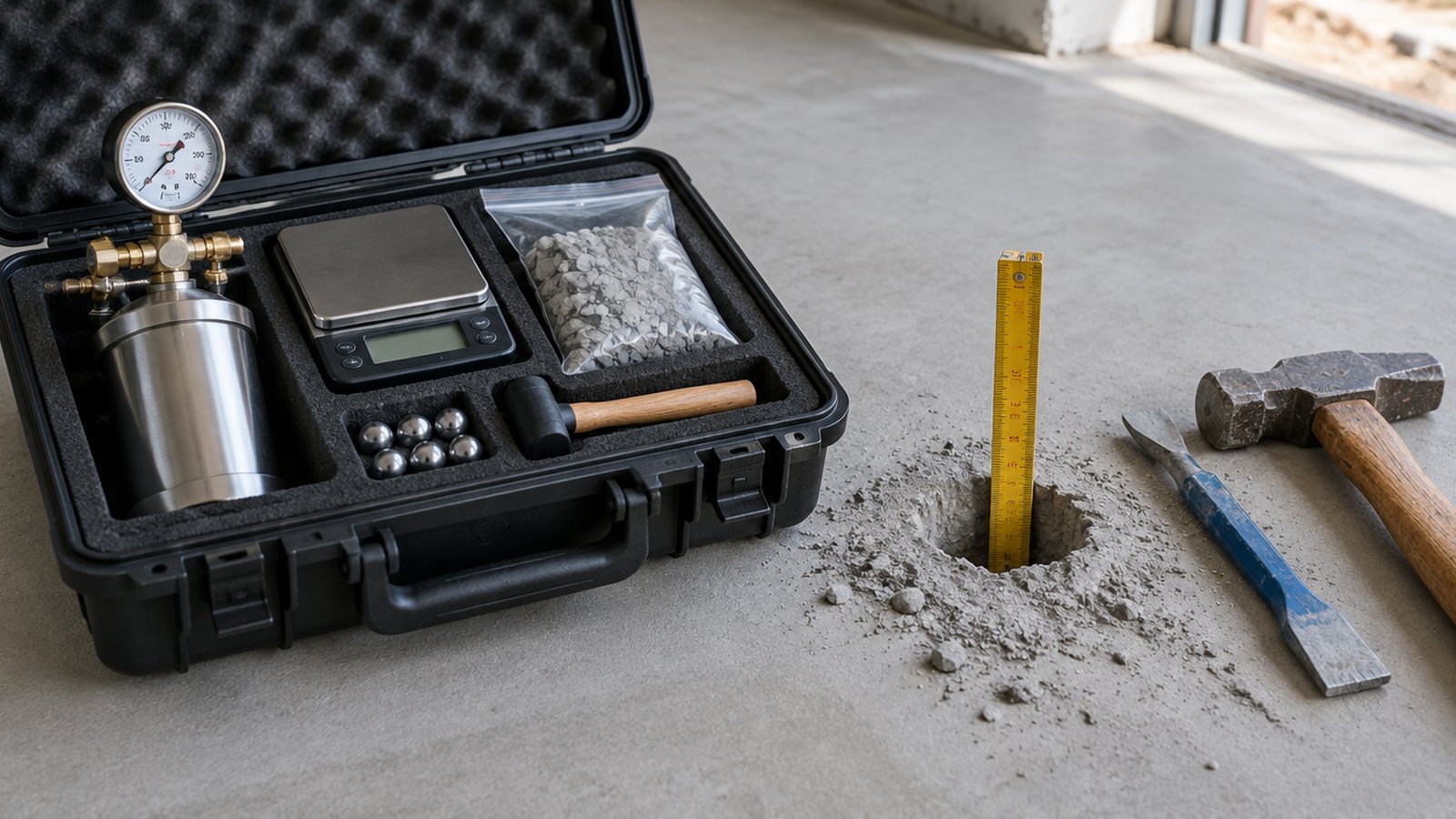
The most reliable is the CM method, also called the carbide method. The tradesperson chisels out a small piece of screed from the full depth or the lower part of the layer. The sample is crushed, weighed and put into a steel bottle with an ampoule of calcium carbide. Moisture in the sample creates pressure, and the gauge shows the moisture percentage.
An electronic meter that is only pressed against the floor is good for a quick estimate and for finding wet spots. As the only check before parquet or laminate it is not enough, because it does not see well what is happening at the bottom of the layer.
A few tips:
- Book the measurement before you order the floor. That way the material does not sit in the flat for weeks.
- Measure in several places, ideally also where the screed is thickest.
- With underfloor heating, the person laying the screed should mark measuring points in advance so no pipe gets drilled.
- Ask for a written record. The flooring installer has the right to postpone the job if the screed is too damp. Better that than a new floor that lifts.
Drying screed with underfloor heating
Underfloor heating is not switched on as soon as the screed hardens. Under the EN 1264-4 standard, functional heating comes first:
- For cement screed it starts at the earliest 21 days after laying, for anhydrite screed at the earliest after 7 days, unless the manufacturer says otherwise.
- For the first 3 days the flow temperature is 20–25 °C.
- For the next 4 days the maximum design temperature is held.
- After that the heating is lowered gradually and the room is aired without draughts or sudden cooling.
Functional heating only checks that the heating and the screed work as they should. It does not mean the screed is dry. After that, the screed is usually heated further, following the installer's programme, until a CM test shows the allowed moisture. The temperature is never raised suddenly, because the screed can crack.
Ask the heating installer for a signed heating record. Flooring installers and parquet suppliers often want it. Prices and system types are in underfloor heating cost per m2.
How to speed up screed drying (and what not to do)
In the first days, screed needs curing, not drying. Cement needs water to harden. If it dries too fast, the surface gets dusty, shrinks and cracks.
In the first days:
- protect the screed from direct sun, draughts and frost,
- if the manufacturer says so, lightly dampen it or cover it with foil for a few days,
- do not point heaters at the floor.
Once the screed has cured:
- air the room briefly and fully several times a day instead of leaving a window open all the time,
- with moderate heating, run a dehumidifier with enough capacity and empty the tank regularly,
- let a fan mix the air in the room rather than blow at one spot all the time,
- do not use gas heaters indoors, because burning gas adds extra moisture to the air.
Screed drying in winter
Screed dries most slowly in winter. One manufacturer requires an air and base temperature between +5 and +30 °C while laying and drying. Below that, screed should not be laid without special measures.
The most common mistake is keeping the flat fully closed and switching on a heater now and then. The moisture stays in the air and the screed barely dries. It is better to heat moderately all the time, air the room briefly and let a dehumidifier run.
If you are renovating in winter, leave more time between the screed and the floors. The order and timing of a whole renovation are in apartment renovation cost per m2.
Example: 5 cm screed poured on 1 December
This is a made-up example, and the calculation is ours. A 5 cm cement screed is poured on 1 December in a flat without underfloor heating. Laminate comes next.
- At the earliest, per the manufacturer: 28 days, so around 29 December.
- Using the rule of about 10 days per cm: about 50 days, so around 20 January.
- In winter, in a cold flat without a dehumidifier: it can take even longer.
So do not book the laminate for late December. Arrange a CM test around mid-January. If it shows up to 2.0 %, laying can start. If moisture is higher, you wait and measure again.
Common mistakes
- Laying the floor because "enough weeks" have passed, without a measurement.
- Turning underfloor heating up to full right after pouring.
- Doing the screed last, when the floors are already ordered and the move-in date is set.
- Adding too much water to the mix so it spreads more easily.
- Leaving pallets of tiles on fresh screed.
- Relying only on an electronic meter before glued parquet.
When to call a tradesperson
If you need new screed, a CM test or a flooring installer, include in your request:
- the screed type and the date it was poured,
- the thickness, if you know it,
- whether there is underfloor heating,
- which floor you plan: tiles, laminate, parquet or vinyl,
- the area and the number of rooms,
- whether you also need a dehumidifier or just the measurement.
How to write a good request is explained in how to write a request to a tradesperson. For floors see the category floors or floors in Zagreb, for screed masonry work and dry screed, and for tiles tiling.
Find a tradesperson with Gigron
On Gigron you post a job for free and tradespeople reply with offers. Write what screed you have and when it was poured, then compare the offers. Get the app:
FAQ
How long does a 5 cm screed take to dry?
A 5 cm cement screed is ready at the earliest after 28 days. Using the rule of about 10 days per centimetre that is about 50 days, and longer in winter. A fast-setting screed can be ready in a few days. You only know for sure after a CM test.
When can you walk on screed?
On cement screed you can usually walk carefully after a few days, and on some fast-setting screeds after 12 hours. Wait longer before putting heavy loads and pallets on it.
When can you switch on underfloor heating on new screed?
For cement screed at the earliest after 21 days, for anhydrite screed at the earliest after 7 days, unless the manufacturer says otherwise. The temperature is raised gradually, following the protocol.
How much moisture can screed have for laminate?
For cement screed the usual limit is up to 2.0 CM %, and up to 1.8 % with underfloor heating. For anhydrite screed about 0.5 %, or 0.3 % with underfloor heating.
Summary
Screed drying time is not something you read off a calendar. Standard cement screed needs at least 28 days, and a 5–6 cm layer can take two months using the rule of about 10 days per cm. Fast-setting screeds cut that to days, and dry screed has no wet drying. In the first days, protect the screed from sun, draughts and frost. Later, air the room briefly, heat moderately and use a dehumidifier. Before tiles, laminate or parquet, always ask for a CM moisture test.
Need someone for a job?
Describe what you need, where and by when.
The AI assistant writes the post; you post it in the Gigron app.