Suspended ceiling cost per m² in Croatia 2026: drywall, grid, stretch
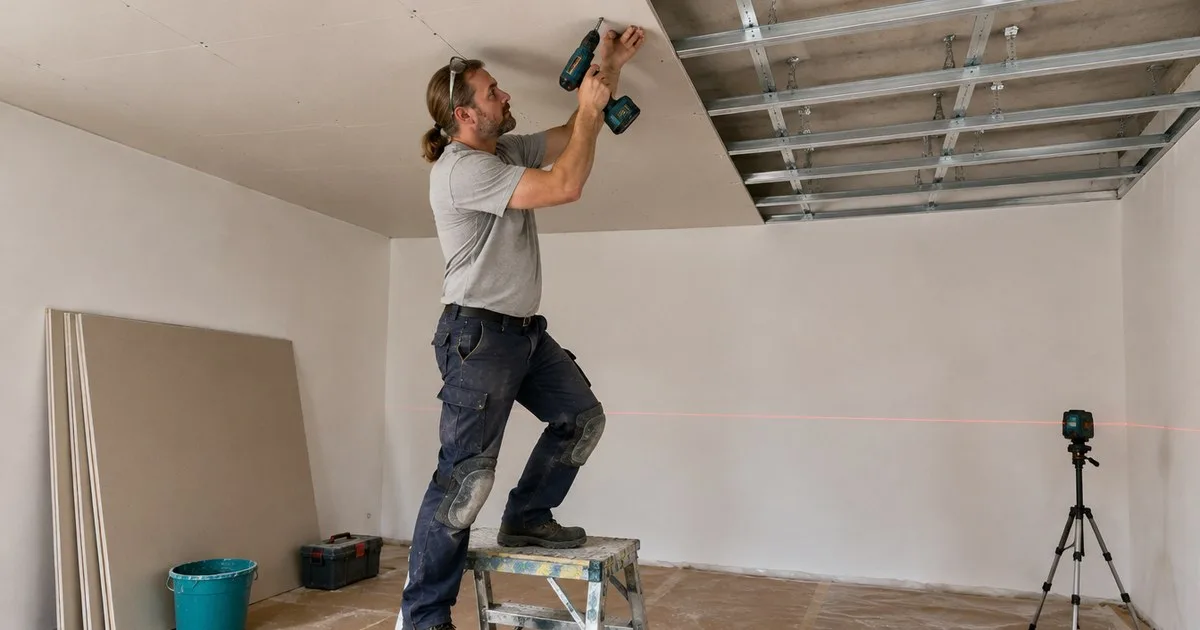
Is your ceiling cracked or uneven, or do you want to hide cables and add recessed lights? Then you will almost certainly ask how much a suspended ceiling costs. Search for suspended ceiling cost per m² in Croatia and you will see numbers from about twenty to ninety euros per square metre. The gap is big because a suspended ceiling is not one product. There are plasterboard ceilings (in Croatia usually just called "knauf"), grid ceilings with 60 × 60 tiles (often called Armstrong) and stretch ceilings made of tensioned film, and each is priced differently.
In this guide you will find approximate 2026 prices per m² for all three types, what recessed spotlights and LED strips cost, the extras that push the bill up, and an example for a living room.
Suspended ceiling cost per m²: approximate ranges
The figures below are approximate ranges from public price lists and calculators of contractors in Croatia (2026). They are not a Gigron quote or a fixed price. They depend on the city, room size, how far the ceiling is dropped, the board type and what the quote includes. Some price lists include VAT (PDV) and some do not, so always check.
| Ceiling type | Approx. (€ per m²) |
|---|---|
| Plasterboard ("knauf"), flat ceiling, labour and materials | ~32–55 |
| Plasterboard ceiling dropped lower or levelled (uneven old ceiling) | ~36–55 |
| Plasterboard ceiling, labour only (you buy the materials) | ~14–30 |
| Grid ceiling (Armstrong type) with 60 × 60 mineral tiles | ~20–42 |
| Stretch ceiling (tensioned film), white or coloured | ~40–50 |
| Stretch ceiling with a printed design | ~65 |
For plasterboard, the price per m² usually covers the metal frame, boards, screws and taping of the joints. Skim-coating the whole surface and painting are often separate items. Grid and stretch ceilings do not need that, because they are finished as soon as they are installed.
Which type of suspended ceiling do you need
| Plasterboard ("knauf") | Grid (Armstrong type) | Stretch ceiling | |
|---|---|---|---|
| Look | Smooth, white, like a normal ceiling | Visible grid of 60 × 60 tiles | Smooth, matt or gloss, can be coloured |
| Finishing | Skim coat and paint | None | None |
| Access to services above | Only through an access hatch | Every tile lifts out by hand | Installer can take the film down and refit it |
| Dust and mess | Most: cutting and sanding | Little | Little |
| Typical use | Flat, house, bathroom, hallway | Office, shop, basement, plant room | Flat, bathroom, shop |
Plasterboard is the most common choice for flats. You can add steps, recesses and hidden LED lighting. For plasterboard walls and ceilings in more detail, see our guide to plasterboard (knauf) cost per m².
An Armstrong-type grid ceiling is cheaper in its basic version and faster to install. Tiles sit in a visible metal grid and each one can be lifted. That makes it a good fit where pipes, ventilation or cables above the ceiling need to stay accessible. For flats and houses, contractors more often recommend plasterboard, because a grid ceiling looks more like an office.
A stretch ceiling is PVC film or fabric tensioned into an aluminium profile around the edge of the room. It goes up without sanding or skim-coating, and according to one installer you do not have to move the furniture out. Installers usually price it per m² with a minimum charge for small rooms. One installer's minimum is €600, so a small bathroom works out more expensive per m².
Suspended ceiling with lighting: spotlights and LED strips
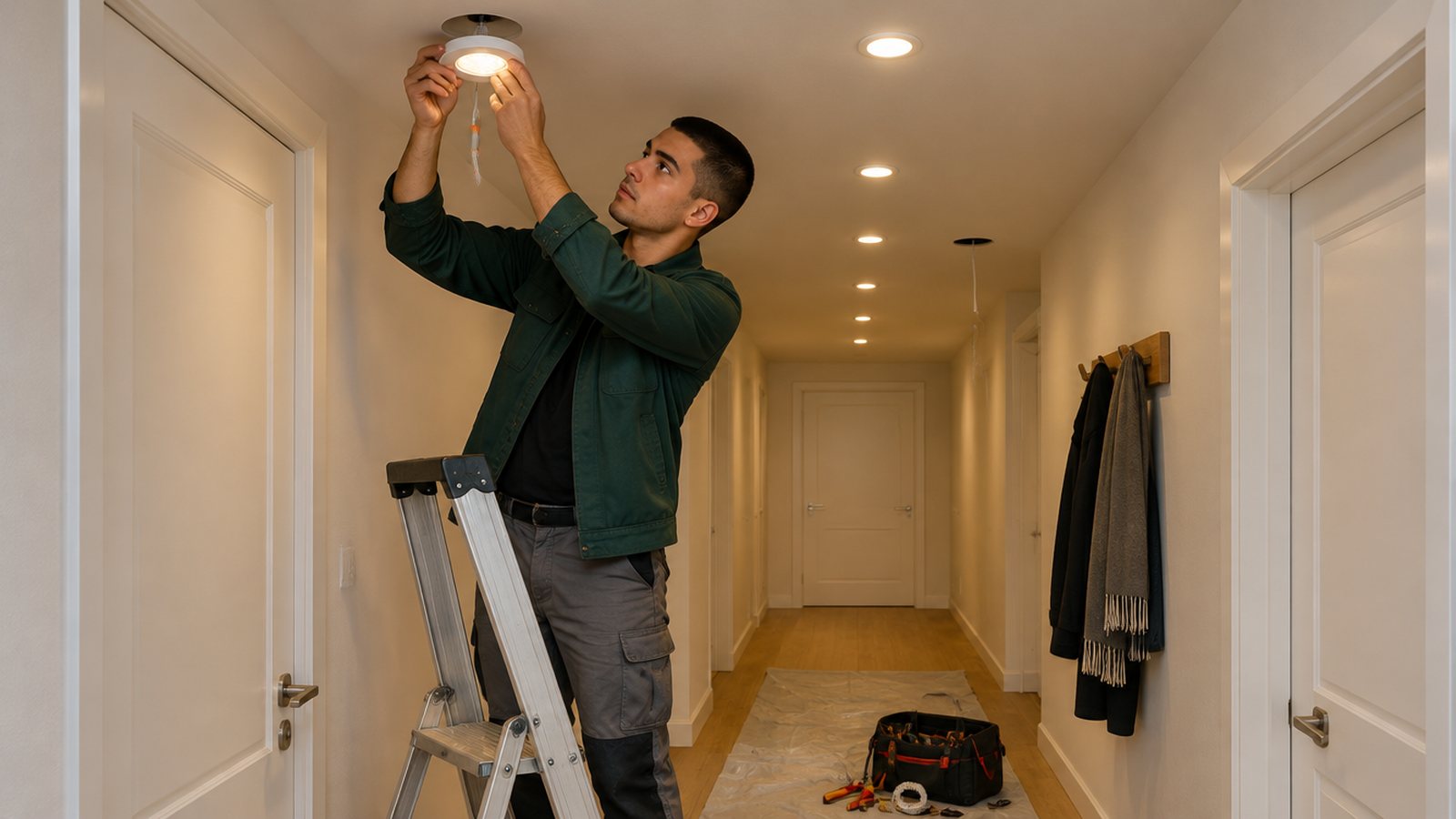
Many people drop the ceiling partly for the lighting. Spotlights and LED strips are charged separately, on top of the ceiling price per m².
| Item | Approx. (€) |
|---|---|
| Fitting one recessed spotlight in a plasterboard ceiling (labour, fitting not included) | ~35–65 each |
| Installing an LED strip in an aluminium profile (labour) | ~12 per metre |
| Light fitting in a stretch ceiling (one installer's price) | ~50 each |
| Light line in a stretch ceiling | ~58–100 per metre |
| Step, recess or channel for indirect lighting (labour, materials extra) | ~50–90 per m² |
Agree on the lighting layout before the ceiling is closed. Cables are run while the frame is still open. Adding a spotlight later means new cutting, taping and painting.
Electrical work must be done by an electrician. In a bathroom, fittings above the shower or bath need at least IP44 protection.
How much height you lose
Every suspended ceiling takes some height from the room. Roughly:
- flat plasterboard ceiling without spotlights: about 5–7 cm,
- plasterboard ceiling with spotlights: usually 8–10 cm, depending on the fitting depth,
- ceiling hiding an air-conditioning or ventilation duct: 15–30 cm, usually only in the hallway,
- stretch ceiling: the profile sits at least about 3 cm below the existing ceiling.
If the room is about 2.5 m high, as in many buildings from the 1960s to the 1980s, every centimetre shows. Then it often makes sense to drop the ceiling only in the hallway, or to build a border along one wall with indirect lighting.
What else pushes up the price of a suspended ceiling
- Small area. A 5 m² bathroom needs the same call-out and preparation as a room. That is why the price per m² sits closer to the top of the range.
- Uneven or worn old ceiling. Longer hangers and more levelling work.
- Board type. Bathrooms and kitchens need moisture-resistant (green) boards. Double boards for better sound insulation mean more material and labour.
- Insulation. Mineral wool above the ceiling, for noise or in an attic, is a separate item.
- Access hatch. If a valve, unit or joint stays above the ceiling, you need a hatch with a door. Roughly €60–90 each.
- Skim coat and paint on plasterboard. If not included, add roughly €11–14 per m². More in our guide to wall painting and skim-coating cost per m².
- Removing an old suspended ceiling. Roughly €3–20 per m², depending on the ceiling type.
- Access. No lift, narrow passages and a flat you are living in all make the job longer.
Example: suspended ceiling in an 18 m² living room
This is a made-up example, for orientation only. Say you want a flat plasterboard ceiling with six recessed spotlights in an 18 m² living room (4.5 × 4 m). The old ceiling is sound, and you are pricing per m².
| Item | Calculation | Approx. (€) |
|---|---|---|
| Flat plasterboard ceiling, labour and materials | 18 m² × €32–55 | ~580–990 |
| Fitting 6 spotlights (labour, fittings not included) | 6 × €35–65 | ~210–390 |
| Skim coat and paint | 18 m² × €11–14 | ~200–250 |
| Total | ~990–1,630 |
Light fittings, LED strips and any new cabling are not included. The same living room with a stretch ceiling would cost roughly €720–900 (18 m² × €40–50), with no skim coat or paint, but with each light priced separately.
Questions to ask before you agree on the job
- Is the price per m² with materials or labour only?
- Is VAT (PDV) included?
- Does it include only taping the joints, or also skim-coating the whole surface and painting?
- Which boards will be used, and are moisture-resistant boards planned for the bathroom?
- How far will the ceiling be dropped, and how much height is left?
- How are steps, recesses and spotlight holes charged?
- Is an access hatch included, if needed?
- Who does the electrical work, and is it in the quote?
- Are protection of the room, cleaning and waste removal included?
Compare at least two or three quotes with the same items. The lowest price per m² often means something on this list is missing.
When to find a tradesperson through Gigron
A suspended ceiling looks simple, but mistakes show later. Too few hangers and profiles mean the ceiling sags over time and the joints crack. The joint between ceiling and wall has to be detailed so you do not get a crack in the corner.
On Gigron, see the categories ceiling lowering and drywall. In Zagreb, see ceiling lowering in Zagreb and drywall in Zagreb. There are also ceiling lowering in Rijeka, ceiling lowering in Pula, drywall in Osijek and drywall in Split. For spotlights and cabling, see electrical installations, and for painting the ceiling, painting and decorating.
If you are also building a partition wall, see the prices in plasterboard (knauf) cost per m².
How to write a good request on Gigron
The clearer your request, the faster you get quotes you can compare. Include:
- which room and how many m² (length × width),
- the ceiling type you want: plasterboard, grid or stretch, if you know,
- the room height and how far it may be dropped,
- lighting: number of spotlights, LED strips, steps,
- special conditions: bathroom, air-conditioning duct, an old ceiling that keeps cracking,
- finishing: whether you need skim coat and paint,
- city, floor and preferred dates.
Add photos of the ceiling and the whole room. More tips in our guide on how to write a request to a tradesperson.
Example request (made up): "I need a flat plasterboard suspended ceiling in an 18 m² living room (4.5 × 4 m). The room is 2.65 m high. I want six recessed spotlights and an LED strip along one wall. Please quote per m² and in total, including VAT, with skim coat and paint. Rijeka, 2nd floor, the building has a lift. End of November suits me."
Find a tradesperson for a suspended ceiling on Gigron
On Gigron you post a request and local tradespeople reply with quotes. It is free, and you do not have to call ten numbers.
Download the app:
Frequently asked questions
How long does a suspended ceiling take?
For plasterboard in a 15–20 m² room, the frame and boards usually go up in one to two days. With skim coat and paint, allow about a week because each layer needs to dry. Grid and stretch ceilings are finished as soon as they are installed.
Is it cheaper to skim-coat the old ceiling or build a suspended one?
If the old ceiling is sound and roughly flat, a skim coat and paint (roughly €11–14 per m²) is much cheaper. A suspended ceiling pays off when the old ceiling keeps cracking or is very uneven, when you need to hide services, or when you want recessed lighting.
Do I need a permit for a suspended ceiling in a flat?
As a rule, a suspended ceiling inside a flat does not need a building permit, because the load-bearing structure is not touched. If the building is a protected cultural heritage site, check before work whether you need conservation approval. Tell your neighbours before drilling into the ceiling and follow the building's house rules.
In short: suspended ceiling cost per m² in Croatia in 2026 is roughly €32–55 for plasterboard, €20–42 for an Armstrong-type grid ceiling and about €40–50 for a stretch ceiling. Spotlights, LED strips, steps, skim coat and paint are charged separately. Ask for a quote per m² and in total, item by item.